
Views: 0
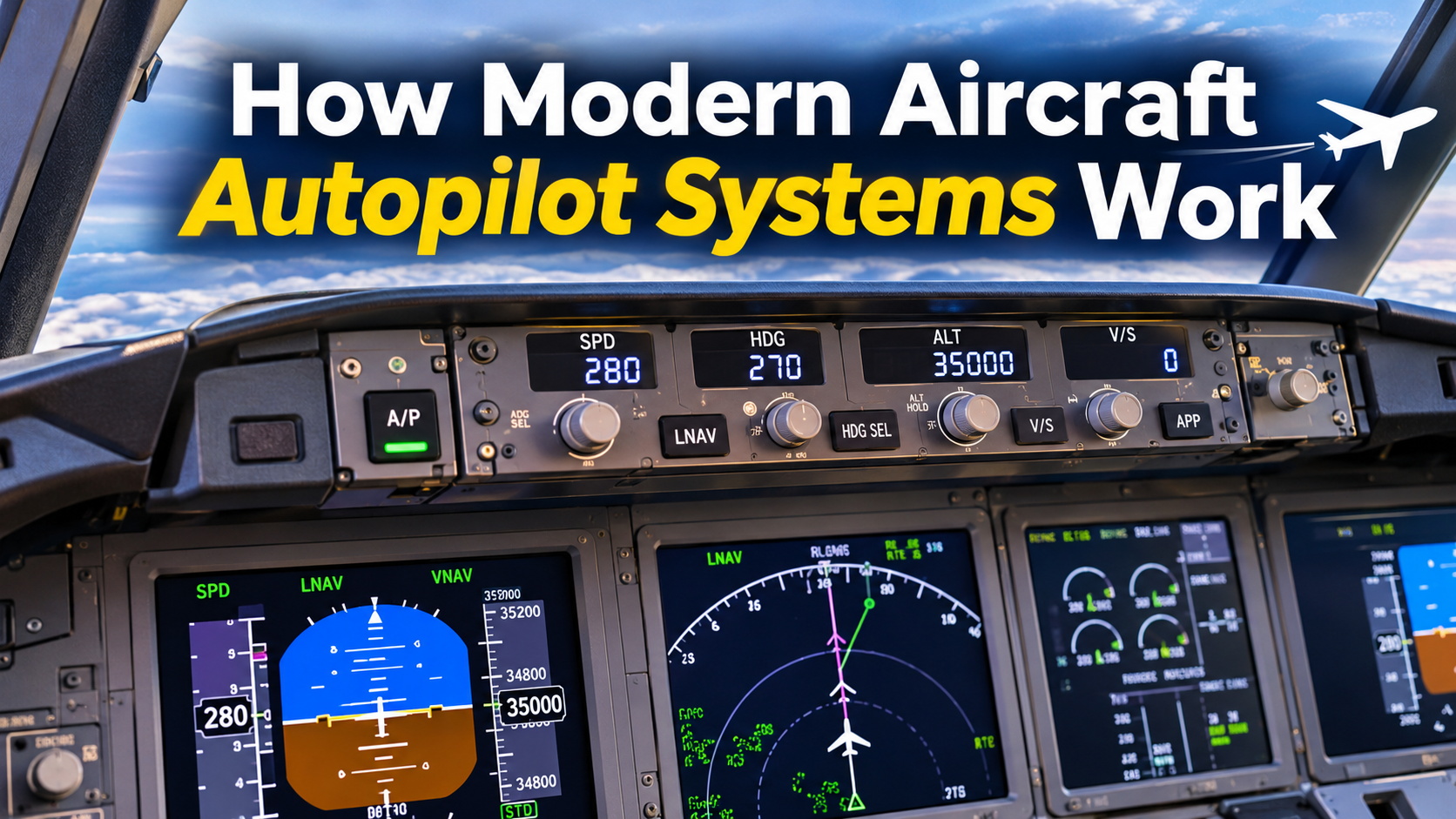
How Modern Aircraft Autopilot Systems Work
Modern aircraft can fly thousands of kilometers while maintaining precise altitudes, speeds, and navigation routes. Behind this remarkable capability is the aircraft autopilot system, one of the most important technologies in modern aviation.
Autopilot does not replace human pilots. Instead, it helps them control the aircraft accurately, reduces workload during long flights, and allows crews to concentrate on navigation, weather, communication, and overall flight safety.

What Is an Aircraft Autopilot?
An autopilot is an electronic system that automatically controls certain aspects of an aircraft’s flight. Depending on its capabilities and operating mode, it can maintain an assigned altitude, follow a selected heading, track a navigation route, or guide the aircraft during an instrument approach.
Modern airliners integrate autopilot with navigation equipment, flight directors, aircraft sensors, and flight management computers.
Together, these systems form a sophisticated automatic flight-control architecture that helps the aircraft follow instructions selected or authorized by the flight crew.
1. The Main Components of an Autopilot System
Flight Sensors
Autopilot systems rely on continuous information from aircraft sensors and navigation instruments.
- Air-data systems: Measure information such as airspeed, altitude, and air pressure.
- Inertial sensors: Provide aircraft attitude and movement information.
- GPS and navigation receivers: Help determine aircraft position and navigation guidance.
- Radio altimeters: Measure height above terrain directly beneath the aircraft, particularly during approach and landing.
Flight-Control Computers
Flight-control computers compare the aircraft’s actual condition with the selected target. They calculate the necessary adjustments and send commands to the appropriate control systems.
Control Actuators
Actuators convert computer commands into physical movements of aircraft control surfaces, including elevators, ailerons, and other surfaces depending on the aircraft design.
Flight Management System (FMS)
The FMS manages flight-plan and performance information. It can provide lateral and vertical navigation guidance to the automatic flight system.
2. How Autopilot Actually Controls an Aircraft
The fundamental principle behind aircraft autopilot is called closed-loop feedback control.
Imagine an aircraft flying at 35,000 feet. If a disturbance causes it to move away from the selected altitude, the autopilot detects the difference and calculates a correction.
- Sensors measure the aircraft’s current altitude and movement.
- The flight-control computer compares the measurements with the selected target.
- The computer calculates the required control adjustment.
- Actuators move the appropriate flight-control surfaces.
- Sensors measure the result, allowing the computer to refine its commands.
This cycle repeats continuously, helping maintain accurate and stable flight.

3. Understanding Autopilot Flight Modes
Aircraft autopilots offer several modes that control different aspects of flight. Pilots select or arm these modes based on their clearance, flight plan, and current flight conditions.
| Mode | Function |
|---|---|
| Heading (HDG) | Follows a selected compass heading. |
| Altitude Hold | Maintains the captured altitude. |
| Vertical Speed | Controls a selected climb or descent rate. |
| LNAV | Follows lateral flight-plan guidance. |
| VNAV | Follows programmed vertical guidance. |
| Approach (APP) | Captures and follows supported instrument approach guidance. |
Mode names and their exact behavior vary between aircraft manufacturers and models. Pilots continuously monitor flight-mode annunciations to confirm what the automation is doing.
4. How Autopilot Is Used During a Flight
Takeoff
Commercial airline takeoffs are generally performed manually. Pilots may use flight directors and automatic thrust systems to help follow the required takeoff guidance.
Climb
Once the aircraft reaches the minimum permitted engagement altitude, pilots may activate autopilot. The system can follow selected climb guidance and the planned navigation route.
Cruise
During cruise, autopilot is especially valuable. It continuously makes small adjustments to maintain selected flight conditions and track the intended route.
Descent
During descent, pilots can use selected or flight-management-generated guidance while monitoring speed, altitude restrictions, and air traffic control instructions.
Approach and Landing
Autopilot can help guide the aircraft along approved instrument approach paths. On suitably equipped aircraft, it may also support an automatic landing.

5. Can an Aircraft Land Automatically?
Yes. Many modern commercial aircraft are equipped with automatic landing capabilities, commonly called autoland.
When the aircraft, airport, crew, and operating conditions meet the applicable requirements, autoland can control the aircraft during the final approach, flare, and touchdown. Some systems also provide rollout guidance after landing.
Autoland relies on suitable navigation guidance, aircraft sensors, flight-control computers, and other integrated systems.
However, automatic landing is not available under every circumstance. Pilots must verify that the aircraft and runway support the procedure and remain prepared to intervene.
6. Autopilot vs. Fly-by-Wire Technology
Autopilot and fly-by-wire are related, but they serve different purposes.
Autopilot automatically follows flight-control guidance to manage aircraft movement.
Fly-by-wire uses electronic signals and computers to transmit and process flight-control commands rather than relying exclusively on mechanical linkages.
A fly-by-wire aircraft can be flown manually, and an autopilot can operate on aircraft that do not have full fly-by-wire flight controls.
7. What Happens If Autopilot Fails?
Modern aircraft incorporate monitoring systems, alerts, and, where appropriate, redundant flight-control equipment.
If an autopilot malfunction occurs, the system may disconnect or change operating modes, depending on the failure and aircraft design.
Flight crews are trained to identify automation problems, understand aircraft alerts, and assume manual control when necessary.
Redundancy helps improve reliability, but it does not make any system completely immune to failure.
8. Does Aircraft Autopilot Use Artificial Intelligence?
Most conventional airliner autopilots rely on established control algorithms, certified avionics software, and predefined operating logic rather than human-like artificial intelligence.
These systems are designed to deliver predictable and verifiable behavior under defined operating conditions.
Artificial intelligence and machine learning are being researched for various aviation applications, but they should not be confused with the standard autopilot functions operating aboard today’s commercial airliners.
9. Why Human Pilots Are Still Essential
Even highly automated aircraft require skilled pilots to supervise the flight.
Pilots manage weather decisions, air traffic control instructions, flight planning, system failures, emergency procedures, and the safe use of automation.
They must also verify that the autopilot is following the intended mode and flight path.
The goal of automation is not to remove human judgment but to support pilots with precise and reliable tools.
Conclusion
Modern autopilot systems combine aircraft sensors, flight-control computers, navigation equipment, and responsive actuators to help aircraft fly accurately and efficiently.
From maintaining altitude during long-distance cruise to guiding an aircraft through complex instrument approaches, autopilot technology has become an essential part of commercial aviation.
Nevertheless, the safest approach to modern flight remains a partnership between advanced automation and trained pilots who understand how to operate, monitor, and override it when necessary.
References and Further Reading
- Federal Aviation Administration (FAA) — Pilot training and aircraft systems guidance.
- Airbus — Aircraft technology and flight-control information.
- Boeing — Commercial aircraft and aviation technology.
- Wikimedia Commons — Aviation photography and image licensing.