


Views: 0
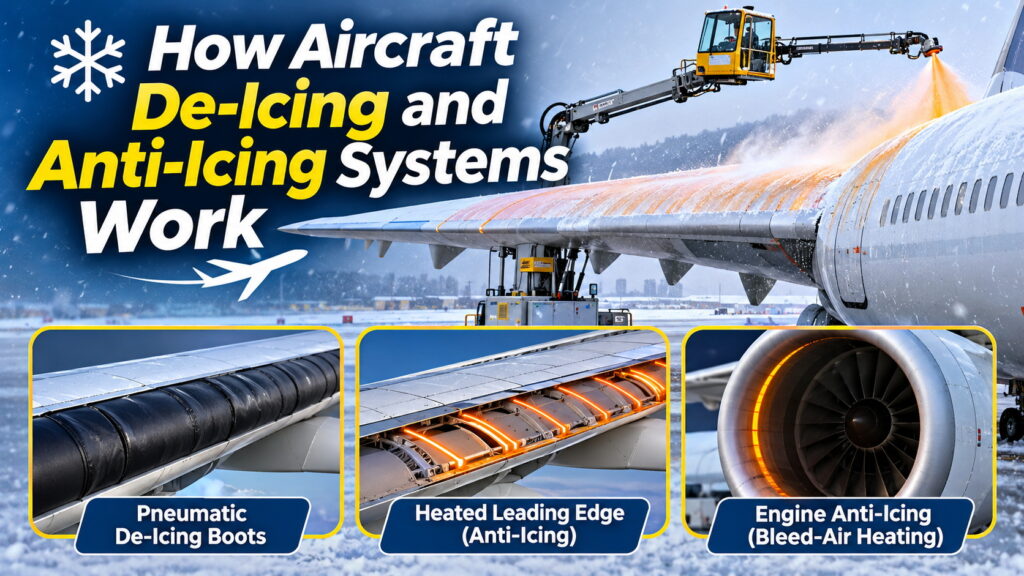
How Aircraft De-Icing and Anti-Icing Systems Work
Aircraft routinely operate in freezing temperatures, snow, freezing rain, and clouds containing supercooled water droplets. Although modern aircraft are designed to withstand demanding weather conditions, ice accumulation remains a significant aviation safety concern.
Even relatively small amounts of ice can change the shape of an aircraft’s wings, increase aerodynamic drag, reduce lift, and interfere with critical instruments.
To manage these risks, aircraft use two essential technologies: de-icing systems, which remove ice that has already accumulated, and anti-icing systems, which prevent or limit ice formation.


1. Why Is Ice Dangerous for Aircraft?
Aircraft wings are carefully designed to generate lift by controlling airflow. When ice forms on a wing’s leading edge or upper surface, it can interfere with this airflow and significantly reduce aerodynamic performance.
Potential consequences include:
- Reduced lift and increased stall speed.
- Higher aerodynamic drag and fuel consumption.
- Changes in aircraft handling characteristics.
- Reduced effectiveness of flight-control surfaces.
- Possible blockage or distortion of instrument readings.
- Disruption of engine airflow in severe conditions.
The danger depends on the amount, location, and shape of accumulated ice. In some circumstances, a relatively small ridge of ice can have a considerable aerodynamic effect.


2. What Is the Difference Between De-Icing and Anti-Icing?
Although the terms are sometimes used interchangeably, they describe different ice-protection functions.
| De-Icing | Anti-Icing |
|---|---|
| Removes ice already present | Prevents or limits ice formation |
| Often operates in cycles | Often operates continuously during icing exposure |
| Examples: pneumatic boots and ground de-icing fluid | Examples: heated wing leading edges and engine inlets |
Some aircraft combine several ice-protection methods, with different systems protecting different components.
3. Pneumatic De-Icing Boots
Pneumatic de-icing boots are commonly found on turboprop aircraft and certain smaller airplanes.
These systems consist of flexible rubber sections attached to the leading edges of wings and other protected surfaces.
When ice accumulates, compressed air inflates the rubber sections, causing them to expand and crack the ice. The airflow around the aircraft then helps remove the fractured ice.
After each cycle, the boots deflate and return to their normal shape.


Advantages of Pneumatic Boots
- Effective removal of accumulated ice from protected surfaces.
- Relatively straightforward mechanical operation.
- Suitable for many turboprop aircraft.
- Typically lower continuous heating demand than large thermal systems.
However, boots require inspection and maintenance, and they protect only the surfaces where they are installed.
4. Thermal Anti-Icing Systems
Many commercial jet aircraft use heat to prevent ice accumulation on critical surfaces.
Engine Bleed-Air Heating
On many turbine-powered aircraft, hot compressed air is extracted from the engines and routed through ducts to heat protected surfaces.
Common applications include:
- Wing leading edges.
- Engine inlet lips.
- Selected airframe components.
Maintaining sufficiently warm surfaces helps prevent supercooled water droplets from freezing on contact.
Bleed-air systems can impose an energy cost on the engines, which is one reason aircraft manufacturers investigate alternative electric technologies.
Electrical Heating
Electrical ice protection uses heating elements integrated into or attached to aircraft components.
Depending on aircraft design, electrically heated components may include:
- Pitot probes and other air-data sensors.
- Cockpit windshields.
- Propeller blades.
- Selected wing and stabilizer surfaces.
Some modern aircraft use extensive electrically powered ice protection rather than relying primarily on engine bleed air.
5. Ground Aircraft De-Icing Before Takeoff
During winter operations, aircraft may accumulate frost, snow, or ice while parked on the ground.
Before departure, trained personnel inspect the aircraft and use approved procedures to remove contamination from critical surfaces.


How Ground De-Icing Works
- Inspection: Ground personnel identify frost, snow, or ice.
- De-icing: Approved fluids, often heated, remove accumulated contamination.
- Anti-icing: Additional protective fluid may be applied when weather conditions require it.
- Protection assessment: Crews assess the applicable holdover time and weather conditions.
- Final verification: Required checks establish that the aircraft is suitable for takeoff.
6. Aircraft De-Icing and Anti-Icing Fluids
Ground de-icing and anti-icing fluids are specifically formulated for aviation use. They commonly contain glycol, water, and other additives.
Different fluid categories are designed for different operating requirements.
- Type I: A relatively low-viscosity fluid commonly used for removing ice and snow. It provides limited ongoing protection.
- Type II: A thickened fluid designed to provide longer protection under suitable conditions.
- Type III: A thickened fluid formulated for certain aircraft with lower rotation speeds.
- Type IV: A thickened fluid commonly used to provide extended ground anti-icing protection where approved.
Thickened anti-icing fluids are designed to flow or shear off during the takeoff roll, within the aircraft’s approved operating envelope.
Not every fluid is suitable for every aircraft. Crews must follow aircraft-specific procedures and applicable fluid approvals.
7. What Is Holdover Time?
Holdover time is the estimated period during which an anti-icing fluid can provide protection against the accumulation of frost or frozen precipitation under specified conditions.
Its duration depends on several factors:
- Type and concentration of fluid.
- Outside air temperature.
- Precipitation type and intensity.
- Applicable regulatory and operational guidance.
Important: Holdover time is an operational guideline, not a guarantee that an aircraft remains free of ice. If conditions exceed the applicable limits, further inspection or treatment may be required.
8. How Pilots Detect and Manage Ice During Flight
Aircraft may encounter icing conditions even when no snow is falling at the departure airport.
Supercooled liquid droplets can remain unfrozen below 0°C and rapidly freeze when they contact an aircraft surface.
Depending on the aircraft, pilots may use ice-detection sensors, visual indicators, weather information, and aircraft-specific procedures to identify and manage icing conditions.
Typical procedures can include:
- Activating approved ice-protection systems.
- Monitoring aircraft performance and system indications.
- Following aircraft-specific speed and configuration guidance.
- Changing altitude or route when necessary to avoid hazardous icing.
Ice protection does not make an aircraft immune to every icing condition. Each aircraft has defined certification and operating limitations.
9. Future Aircraft Ice-Protection Technology
Aircraft manufacturers and researchers continue to investigate technologies that may improve ice protection while reducing energy consumption, weight, and maintenance requirements.
Research areas include:
- More efficient electrothermal heating systems.
- Advanced ice-detection sensors.
- Icephobic and low-adhesion surface coatings.
- Hybrid thermal and mechanical ice-removal methods.
- Improved system monitoring and automation.
These developments may help future aircraft manage icing conditions more efficiently, although new technologies must undergo rigorous testing and certification before operational use.
Conclusion
Aircraft de-icing and anti-icing systems play a vital role in modern aviation safety.
From inflatable rubber boots on turboprops to heated wing surfaces and engine inlets on passenger jets, each technology helps protect aircraft against the aerodynamic and operational dangers of ice.
Ground de-icing procedures are equally important, ensuring aircraft begin their flights with clean, properly protected surfaces.
Understanding these systems reveals the engineering and operational discipline required to maintain safe aircraft performance in challenging winter weather.
References and Image Credits
- FAA – Ground Deicing and Anti-Icing Program
- FAA – Pilot Guide: Flight in Icing Conditions
- U.S. Air Force – KC-135 De-icing Photograph (Public Domain)
- FAA – Pneumatic De-Icing Boots Illustration (Public Domain)
- Nicholas Hartmann – Boeing 737 Wing De-Icing Photograph (CC BY-SA)
- Olivier Cleynen – Engine Inlet Icing Photograph (Wikimedia Commons)
Published by Bin3aiah Planes — Aviation Technology, Aircraft Engineering and Flight Safety.