


Views: 0
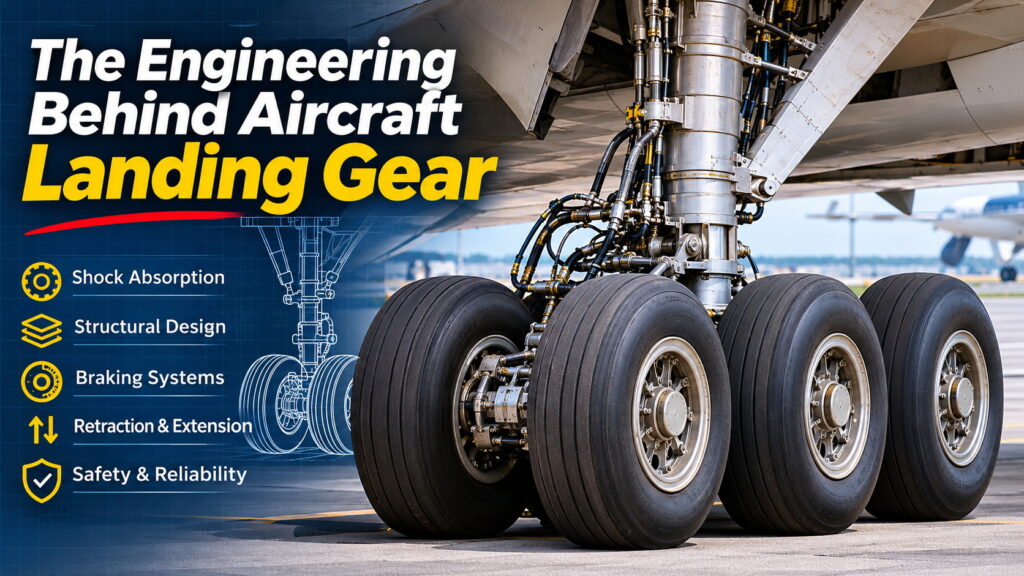
The Engineering Behind Aircraft Landing Gear
Aircraft landing gear is far more than a collection of wheels. It is a highly engineered system designed to absorb tremendous landing forces, support heavy aircraft, provide ground stability, and enable safe braking and steering.
From small private airplanes to giant commercial airliners, landing gear combines structural engineering, hydraulics, advanced materials, and mechanical control systems to withstand some of the most demanding conditions in aviation.


1. Why Aircraft Landing Gear Is So Important
An aircraft’s landing gear must perform several critical functions. It supports the aircraft on the ground, absorbs landing impacts, allows safe taxiing, and helps control the aircraft during takeoff and landing.
Unlike automobile suspension, aircraft landing gear experiences exceptionally high concentrated loads during touchdown. It must also remain dependable after repeated landings, takeoffs, and exposure to changing temperatures, moisture, and runway contaminants.
Modern commercial aircraft generally use a tricycle landing gear configuration consisting of a nose gear assembly and main landing gear assemblies.
2. Shock Absorption: The Oleo-Pneumatic System
One of the most important landing gear components is the oleo-pneumatic shock absorber.
This mechanism uses compressed gas, typically nitrogen, and hydraulic fluid to absorb and dissipate energy when an aircraft touches down.
During landing, the piston compresses into the shock strut. Hydraulic fluid is forced through a restricted passage, generating resistance that dissipates impact energy as heat. Meanwhile, the compressed nitrogen acts as a spring.
As the strut extends again, hydraulic damping helps limit unwanted bouncing.
The result is a controlled landing response that reduces the forces transferred into the aircraft structure.
3. Landing Gear Structure and Materials
Landing gear must handle vertical landing loads, braking forces, lateral loads during crosswind operations, and repeated mechanical stresses.
Manufacturers therefore use materials with high strength and good fatigue performance. High-strength steel alloys are common in major landing gear structures, while titanium alloys may be used in selected applications.
Important landing gear components include:
- Shock strut: Absorbs and dissipates touchdown energy.
- Trunnion: Provides a structural connection and pivot for retractable gear.
- Drag and side braces: Help stabilize the gear in its deployed position.
- Torque links: Maintain alignment between telescoping strut components.
- Axles and bogies: Support multiple wheels and distribute loads.
- Actuators: Move and position retractable landing gear assemblies.
4. Why Large Aircraft Have Multiple Landing Gear Wheels


Large airliners need multiple wheels because their weight must be distributed across a wider area of runway pavement.
For example, the Boeing 777 normally uses two six-wheel main landing gear assemblies and a two-wheel nose gear, giving it 14 wheels in total.
The Airbus A380 uses 22 wheels: 20 on its main landing gear assemblies and two on the nose gear.
Multi-wheel arrangements help manage individual tire loads, improve weight distribution, and accommodate the requirements of very heavy aircraft.
5. How Aircraft Landing Gear Retracts


Retractable landing gear improves aircraft aerodynamic efficiency by allowing the wheels to be stowed inside the fuselage or wings during flight.
On many commercial aircraft, hydraulic actuators supply the force required for retraction and extension.
A typical retraction sequence involves releasing the landing gear downlocks, moving the assemblies into their compartments, and securing them in the retracted position.
During extension, the gear moves into position and mechanical locking systems secure it for landing.
Aircraft also incorporate alternate extension arrangements, which vary by aircraft type and may rely on gravity, stored hydraulic pressure, or other mechanisms.
6. Aircraft Braking Systems
Landing gear engineering also involves controlling the enormous kinetic energy of a moving aircraft.
Modern commercial airliners often use multi-disc braking systems, including carbon brake assemblies designed to tolerate substantial temperatures and braking energy.
Anti-skid systems monitor wheel behavior and regulate braking pressure to help prevent wheel lockup.
Automatic braking systems can provide a selected level of deceleration, reducing the need for continuous manual brake-pressure adjustments by the flight crew.
Landing performance also depends on runway conditions, tire grip, aerodynamic forces, and other deceleration systems, including thrust reversers where fitted.
7. Steering and Crosswind Stability
Landing gear must maintain directional stability while the aircraft moves along a runway or taxiway.
Nose-wheel steering systems allow pilots to maneuver during ground operations. Some large aircraft also incorporate steering on selected main landing gear axles to reduce tire scrubbing during tight turns.
During crosswind landings, landing gear components may experience combined vertical, sideways, and longitudinal loads.
Engineers account for these forces during structural design and testing to ensure the gear can withstand its required operating conditions.
8. Landing Gear Safety and Maintenance
Landing gear systems incorporate multiple safety features, including position indicators, mechanical locks, ground-sensing interlocks, and alternate extension provisions.
Maintenance personnel inspect shock struts, wheel assemblies, tires, brakes, hydraulic components, and structural attachments according to approved maintenance procedures.
Fatigue, corrosion, hydraulic leakage, tire damage, and worn braking components are among the conditions that require careful attention.
Because landing gear is a safety-critical system, its design and maintenance are governed by strict airworthiness requirements.
9. The Future of Landing Gear Engineering
Aircraft manufacturers and suppliers continue to investigate ways to reduce landing gear weight, improve reliability, and simplify maintenance.
Potential developments include improved structural materials, enhanced sensors, more capable condition-monitoring systems, and greater use of electrically powered actuation.
Condition-based and predictive maintenance technologies may allow operators to identify developing component problems earlier, helping reduce unexpected downtime.
However, emerging technologies must still demonstrate adequate reliability, safety, and operational benefits before widespread adoption.
Conclusion
Aircraft landing gear is an impressive example of modern aerospace engineering. Every successful landing depends on a carefully coordinated system of shock absorbers, structural components, wheels, brakes, actuators, and control mechanisms.
Although landing gear disappears from view during most of a flight, its engineering is essential to every safe takeoff, landing, and ground operation.