


Views: 0
How Aircraft Pressurization Systems Work
Modern commercial aircraft fly thousands of feet above the Earth’s surface, often cruising between 30,000 and 40,000 feet. At these altitudes, the surrounding atmosphere is much thinner than at sea level, making it difficult for humans to breathe normally without pressurization or supplemental oxygen.
Despite these extreme conditions, passengers inside an airliner can breathe comfortably, walk through the cabin, and enjoy a relatively normal environment.
This is made possible by one of aviation’s essential technologies: the aircraft cabin pressurization system.
Aircraft pressurization systems regulate cabin air pressure throughout the flight, creating a controlled environment while the aircraft climbs, cruises, and descends.

Why Do Aircraft Need Pressurization?
Atmospheric pressure decreases with altitude. At sea level, air pressure is approximately 101.3 kilopascals, or 14.7 pounds per square inch.
At 35,000 feet, atmospheric pressure is only about one-quarter of its sea-level value.
Although oxygen continues to make up approximately 21% of the atmosphere, the lower pressure means that less oxygen is available to the human body with each breath.
Without pressurization, prolonged exposure to these conditions could lead to hypoxia, impaired judgment, confusion, unconsciousness, and other serious medical consequences.
Pressurization protects occupants by maintaining a cabin pressure equivalent to a much lower altitude.
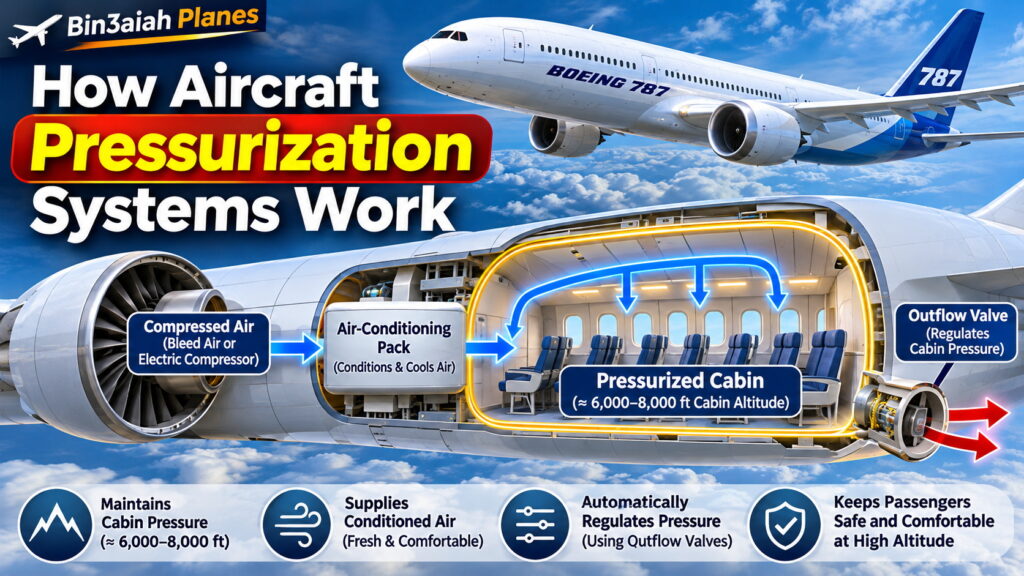
Many conventional commercial airliners maintain a cabin altitude of approximately 6,000 to 8,000 feet during high-altitude cruise, depending on aircraft type and operating conditions.
How Does an Aircraft Pressurization System Work?
Aircraft pressurization is based on a controlled balance between incoming compressed air and outgoing cabin air.
Rather than keeping the cabin completely sealed with a fixed quantity of air, modern aircraft continually introduce conditioned air while allowing a regulated amount to escape.
The amount of air leaving the cabin is controlled primarily by adjustable outflow valves.
A typical conventional system operates through the following sequence:
- Compressed air is supplied by the engines or another designated air source.
- The environmental control system conditions the air to suitable temperatures.
- Conditioned air enters the passenger cabin and flight deck.
- Electronic controllers monitor cabin pressure and aircraft conditions.
- Outflow valves regulate how much air leaves the aircraft.
- The pressure controller adjusts the valves throughout the flight.

Main Components of an Aircraft Pressurization System
1. Compressed Air Supply
On many conventional jet-powered aircraft, compressed air is extracted from the compressor stages of the engines before combustion.
This is commonly known as engine bleed air.
The air is supplied through a network of valves, ducts, and control systems before reaching the environmental control equipment.
However, not every modern aircraft uses this arrangement. The Boeing 787 Dreamliner, for example, uses electrically powered compressors to supply outside air for normal cabin pressurization.
2. Air-Conditioning Packs
Compressed air can be extremely hot, making it unsuitable for direct delivery into the passenger cabin.
Aircraft air-conditioning packs use heat exchangers and air-cycle machinery to cool and regulate the incoming air.
These systems are part of the aircraft’s environmental control system, commonly abbreviated as ECS.
They help manage cabin temperature, ventilation, and the delivery of conditioned air.
3. Outflow Valves
The outflow valve is one of the most important components of the pressurization system.
Its function is to regulate the amount of air escaping from the pressurized fuselage.
When the valve closes further, less air escapes, allowing cabin pressure to increase if the incoming air supply remains sufficient.
When the valve opens further, more air escapes and cabin pressure decreases.
This continuous adjustment allows the aircraft to maintain the required cabin pressure under changing flight conditions.

4. Cabin Pressure Controllers
Modern pressurized aircraft generally use automatic controllers to regulate cabin pressure.
These controllers receive information about the aircraft’s altitude, flight phase, pressure conditions, and programmed operating schedule.
The system then adjusts the outflow valves automatically.
Many commercial aircraft include redundant pressure-control equipment and alternative operating modes to improve reliability.

How Cabin Pressure Changes During Flight
During Takeoff
Before or around takeoff, the aircraft begins following a programmed pressurization schedule.
Some aircraft slightly pressurize the cabin before becoming airborne to reduce abrupt pressure changes during the initial climb.
During Climb
As the aircraft gains altitude, atmospheric pressure outside the fuselage decreases.
The pressure controller regulates the outflow valves so that cabin pressure decreases gradually.
Passengers therefore experience a relatively controlled increase in cabin altitude rather than the rapid pressure reduction occurring outside.
During Cruise
At cruising altitude, the aircraft maintains its scheduled cabin pressure while keeping the pressure differential within the fuselage’s structural limitations.
Although an aircraft may be flying at 37,000 feet, its cabin may be maintained at a pressure equivalent to approximately 7,000 feet.
During Descent
As the aircraft descends, outside air pressure increases.
The pressurization controller gradually increases cabin pressure, allowing the cabin altitude to descend toward the altitude of the destination airport.
This gradual process improves passenger comfort and reduces abrupt pressure changes.
After Landing
When the aircraft lands, the pressurization system equalizes cabin pressure with the surrounding atmosphere.
This is important because aircraft doors must not be opened while a significant pressure differential remains.
Understanding Cabin Altitude and Differential Pressure
Two important measurements are used in aircraft pressurization engineering.
Cabin Altitude
Cabin altitude is the altitude in the standard atmosphere corresponding to the air pressure inside the aircraft.
It does not represent the aircraft’s actual height above the ground.
Differential Pressure
Differential pressure is the difference between the pressure inside the cabin and the surrounding atmosphere.
This pressure difference places structural loads on the fuselage, windows, doors, and other pressure-boundary components.
| Measurement | Illustrative Value |
|---|---|
| Aircraft cruising altitude | 35,000 feet |
| Cabin altitude | 7,000 feet |
| Outside atmospheric pressure | Approximately 3.46 psi |
| Cabin atmospheric pressure | Approximately 11.33 psi |
| Differential pressure | Approximately 7.87 psi |
These figures are illustrative standard-atmosphere calculations, not specifications for a particular aircraft.
The aircraft structure must withstand repeated pressurization cycles throughout its operating life.
How Modern Aircraft Improve Cabin Comfort
Aircraft manufacturers continue to develop environmental control systems to improve efficiency and passenger comfort.
One notable example is the Boeing 787 Dreamliner.
The 787 uses an electrically powered cabin air supply rather than traditional engine bleed air for normal cabin pressurization.
Its composite fuselage design also supports a lower typical cabin altitude than many earlier commercial airliners, with a target cabin altitude of approximately 6,000 feet at maximum cruise altitude.
This can help reduce some of the discomfort associated with long flights.

What Happens if Cabin Pressurization Fails?
Although modern aircraft pressurization systems are designed with multiple safeguards, failures and abnormal pressure conditions can occur.
Aircraft therefore include several protective features.
- Pressure relief valves: Protect against excessive positive pressure differential.
- Negative pressure relief valves: Help prevent damage when outside pressure exceeds cabin pressure.
- Backup pressure controls: Provide alternative control functions in specified failure conditions.
- Cabin altitude warnings: Alert pilots when cabin pressure becomes unsafe.
- Emergency oxygen systems: Supply supplemental oxygen during significant depressurization.
If cabin pressure becomes dangerously low, flight crews follow emergency procedures, which may include using oxygen masks and descending promptly to an appropriate lower altitude.
Why Do Passengers’ Ears Pop During Flight?
Many passengers experience popping, pressure, or temporary discomfort in their ears during takeoff and landing.
This occurs because changes in cabin pressure create a temporary imbalance between the air pressure in the middle ear and the surrounding cabin.
The Eustachian tubes connect the middle ear to the back of the nose and throat, helping equalize pressure.
Swallowing, yawning, and chewing gum can help relieve mild pressure discomfort.
The sensation is usually more noticeable during descent, when cabin pressure increases.
Why Pressurization Is Essential to Modern Aviation
Without reliable cabin pressurization, operating passenger aircraft at today’s typical cruising altitudes would be much more difficult.
Pressurization enables aircraft to take advantage of thinner air at high altitude while protecting passengers and crew from the consequences of low atmospheric pressure.
The system also forms an important part of the aircraft’s overall environmental control architecture, working alongside air conditioning, ventilation, oxygen equipment, and structural safety systems.
Conclusion
Aircraft pressurization systems represent an impressive combination of mechanical engineering, aerodynamics, structural design, and electronic control.
By carefully managing compressed air supply and outflow, these systems allow modern commercial aircraft to operate safely and efficiently at altitudes far above those suitable for normal human breathing.
From the engines and air-conditioning packs to automatic controllers and pressure relief valves, every component contributes to maintaining a controlled cabin environment.
The next time you travel at 35,000 feet, remember that a sophisticated engineering system is continuously working behind the scenes to keep the air around you at a comfortable pressure.
Technical Sources and Further Reading
- Federal Aviation Administration — Aircraft Pressurization
- FAA — Pilot’s Handbook of Aeronautical Knowledge
- Boeing — 787 Dreamliner
Image Credits
Images sourced from Wikimedia Commons. Boeing 787 front view: AlexanderCraker (see file page for license); aircraft pressurization diagram: FAA; Boeing 737 outflow and pressure relief valves and cockpit panel: wsombeck (public domain); EVA Air Boeing 787-9 cabin: 4300streetcar (CC BY 4.0). Linked image pages contain source and license information.