


Views: 0
How Aircraft Weather Radar Detects Storms
Modern commercial aircraft can fly across continents and through rapidly changing weather conditions. One of the most important technologies helping pilots avoid dangerous storms is airborne weather radar.
Using microwave signals, aircraft weather radar detects precipitation ahead of the airplane, helping flight crews identify thunderstorms, heavy rainfall, and potentially hazardous weather.
But how does this technology work, and can it detect every danger hidden inside a thunderstorm?


1. What Is Aircraft Weather Radar?
Aircraft weather radar is an onboard detection system that uses electromagnetic waves to locate precipitation in the atmosphere.
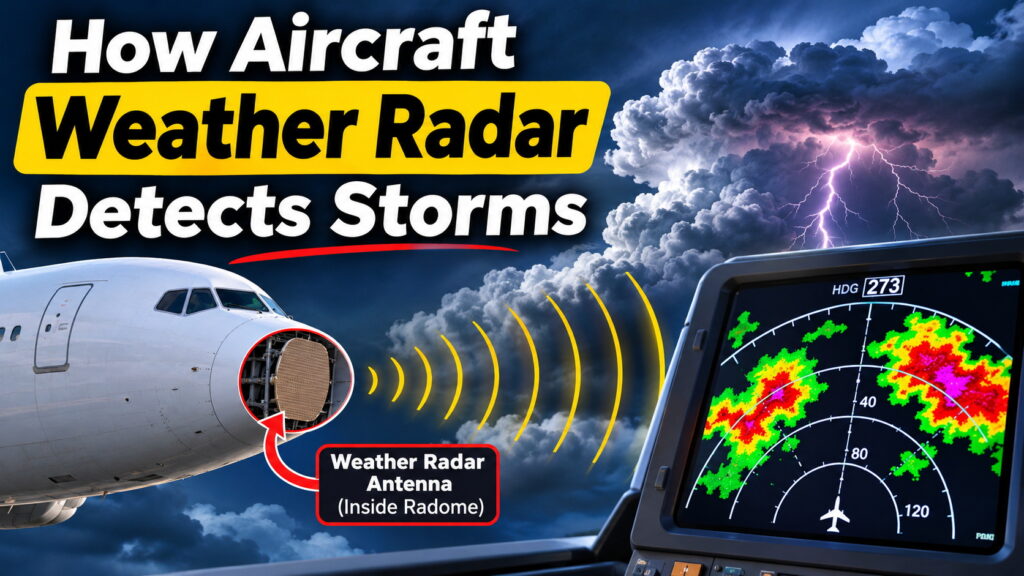
Most commercial aircraft have a weather radar antenna installed inside the nose of the aircraft, protected by a specialized covering called a radome.
The radar repeatedly scans an area ahead of the airplane and provides weather information on the cockpit navigation display.
This allows pilots to identify precipitation-heavy storm cells and make informed decisions about avoiding hazardous weather.
2. How Aircraft Weather Radar Works
Aircraft weather radar typically operates in the X-band microwave frequency range, around 9 GHz.
The detection process involves five main stages:
- Transmission: The radar antenna emits short pulses of microwave energy into the atmosphere.
- Interaction: The electromagnetic waves encounter precipitation particles, including raindrops and hailstones.
- Reflection: Some of the microwave energy is scattered back toward the aircraft.
- Processing: The radar measures the time required for the reflected energy to return and analyzes the signal strength.
- Display: The processed information appears on the aircraft navigation display using different colors.
The time between transmitting a pulse and receiving its echo indicates how far away the precipitation is.
The strength of the returned signal helps estimate radar reflectivity, which is related to the characteristics and concentration of precipitation particles.


3. Understanding Weather Radar Colors
One of the most recognizable features of aircraft weather radar is its color-coded display.
Different colors represent the strength of precipitation returns, helping pilots interpret weather conditions quickly.
| Radar Color | Typical Meaning |
|---|---|
| Green | Relatively weak precipitation returns |
| Yellow | Moderate precipitation returns |
| Red | Strong returns and potentially intense precipitation |
| Magenta | On certain systems, extreme returns or special hazard indications |
Exact color thresholds depend on the radar manufacturer and display settings.
Important: Radar colors indicate return intensity, not a direct measurement of turbulence. Hazardous turbulence may exist outside the strongest precipitation areas.


4. How Radar Helps Pilots Avoid Thunderstorms
Thunderstorms can create some of the most hazardous atmospheric conditions encountered during flight.
Potential dangers include:
- Severe turbulence
- Heavy precipitation
- Large hailstones
- Lightning
- Strong updrafts and downdrafts
- Aircraft icing
- Wind shear and microbursts
Weather radar helps flight crews identify areas of significant precipitation associated with developing or mature storm cells.
Pilots examine the location, intensity, and shape of radar echoes to understand where the most threatening weather may be located.
Rather than flying through intense storm cells, flight crews normally seek a safer route around them.
The US Federal Aviation Administration recommends avoiding thunderstorms identified as severe or producing intense radar echoes by at least 20 miles. The appropriate separation depends on the storm and operational conditions.
5. Why Radar Antenna Tilt Matters
Weather radar does not scan the entire atmosphere simultaneously. Its antenna directs a beam of microwave energy toward selected elevations.
Adjusting the antenna’s vertical angle, known as radar tilt, is an important part of interpreting weather.
If the antenna points too high, it may scan above significant precipitation. If it points too low, the radar may detect terrain instead of the weather ahead.
Correct tilt management helps pilots investigate precipitation at different heights and recognize important storm structures.
Some modern radar systems automatically manage scanning angles and combine observations from multiple elevations.
6. Can Aircraft Weather Radar Detect Turbulence?
Aircraft weather radar is extremely useful, but it cannot directly detect all forms of turbulence.
Conventional weather radar primarily detects precipitation particles.
Some advanced Doppler radar systems can identify turbulence associated with precipitation by analyzing differences in the motion of detected particles.
However, clear-air turbulence, which occurs without significant precipitation, can remain invisible to onboard weather radar.
This is why pilots also use aviation forecasts, pilot weather reports, aircraft observations, and information from air traffic control when assessing turbulence risks.
7. Limitations of Aircraft Weather Radar
Despite major technological improvements, airborne weather radar has several important limitations.
Radar Attenuation
Heavy precipitation can absorb and scatter microwave energy, weakening the radar signal.
This may cause dangerous storm cells behind an intense precipitation area to appear weaker or disappear from the display.
Dry Weather Hazards
Weather radar may not reveal strong turbulence, wind shear, or other atmospheric disturbances when precipitation returns are insufficient.
Beam Geometry
Radar scans only the region illuminated by its antenna beam. Incorrect tilt or scan selection may cause important weather features to be missed.
Interpretation
Strong radar returns do not describe every storm hazard. Experienced crews consider the broader weather situation rather than relying on a single display indication.
8. Modern Aircraft Weather Radar Technology
Advanced airborne radar systems use sophisticated digital processing to present a more comprehensive picture of surrounding weather.
Depending on the system, capabilities can include:
- Automatic antenna tilt management
- Multiple-elevation scanning
- Three-dimensional precipitation analysis
- Doppler-based turbulence detection in precipitation
- Improved compensation for signal attenuation
- Enhanced weather threat presentation
Some systems also integrate weather information with electronic cockpit displays, reducing the workload associated with manually examining radar returns.
9. Aircraft Radar vs. Ground Weather Radar
Aircraft weather radar and ground-based meteorological radar both use reflected electromagnetic signals, but their operational roles differ.
Airborne radar gives pilots an onboard view of precipitation within the radar’s scanned region.
Ground-based radar monitors weather over large geographical areas and supports forecasting, air traffic operations, and weather monitoring.
Ground-derived weather images transmitted to aircraft through data links are especially useful for strategic planning.
However, transmitted weather products can be delayed and should not replace onboard radar for making immediate weather avoidance decisions.
10. Why Weather Radar Is Essential for Flight Safety
Weather radar is one of the most important systems used by modern flight crews to understand precipitation hazards ahead of an aircraft.
It helps pilots:
- Recognize potentially dangerous storm cells
- Plan deviations around hazardous precipitation
- Improve awareness of developing weather threats
- Reduce unnecessary exposure to intense convective weather
- Make more informed operational decisions
Although radar cannot identify every atmospheric danger, combining radar information with meteorological forecasts and professional flight procedures significantly improves weather awareness.
Conclusion
Aircraft weather radar uses microwave energy to detect precipitation and display storm activity ahead of an airplane.
By analyzing reflected signals, the system provides pilots with useful information about the location and intensity of precipitation.
Modern radar technologies improve this capability through automated scanning, advanced signal processing, and enhanced cockpit displays.
Ultimately, the greatest value of aircraft weather radar is not enabling pilots to fly through dangerous thunderstorms, but helping them recognize and avoid hazardous conditions before encountering them.