


Views: 3
The Engineering Behind Variable-Sweep Aircraft Wings
How can one aircraft deliver excellent low-speed handling and supersonic performance? For decades, engineers explored an innovative solution: wings that physically change their sweep angle during flight.


1. What Are Variable-Sweep Wings?
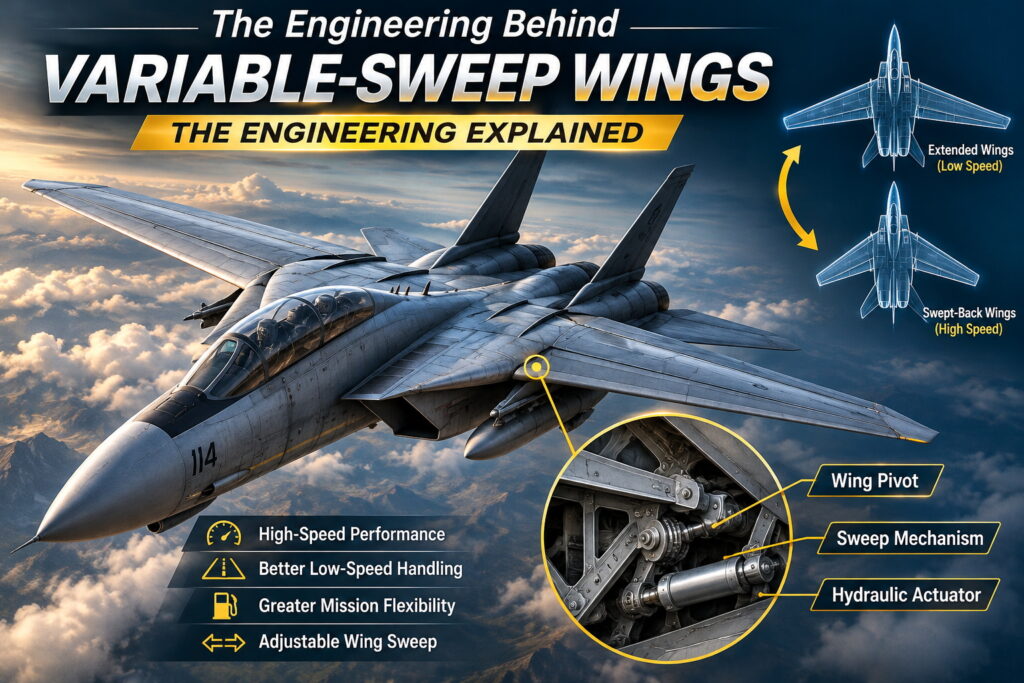
A variable-sweep wing, commonly called a swing wing, is an aircraft wing that can rotate backward or forward around a structural pivot during flight.
Unlike a conventional fixed-wing aircraft, a swing-wing aircraft can alter its wing geometry to accommodate different aerodynamic conditions.
At lower speeds, the wings generally extend forward to provide greater effective wingspan and improved low-speed lift characteristics.
At higher speeds, the wings sweep backward to improve the aircraft’s transonic and supersonic aerodynamic characteristics.
2. Why Aircraft Need Different Wing Shapes
Low-Speed Flight
During takeoff, approach and landing, aircraft need sufficient lift at relatively low airspeeds. A less-swept wing generally provides better low-speed lift effectiveness and supports lower approach speeds.
Greater effective span also helps reduce induced drag under suitable flight conditions.
High-Speed Flight
As aircraft approach the speed of sound, compressibility effects become increasingly important. Shock waves can form, producing additional drag and complicating aircraft handling.
Sweeping the wing backward reduces the component of the airflow velocity perpendicular to the wing’s leading edge.
This can delay some compressibility effects and improve the wing’s performance at high Mach numbers.
The Engineering Compromise
A highly swept wing optimized for fast flight may deliver less favorable low-speed characteristics. A less-swept wing optimized for takeoff and landing may experience greater aerodynamic penalties at transonic speeds.
Variable sweep was developed to address this fundamental compromise.
3. How the Wing-Sweep Mechanism Works
The defining feature of a swing-wing aircraft is its mechanical wing-pivot assembly.
Each movable wing panel rotates around a heavily reinforced pivot connected to the aircraft’s central structure.
Major Engineering Components
- Wing pivot: Transfers major aerodynamic loads from the moving wing into the fuselage or wing carry-through structure.
- Hydraulic actuators: Generate the force required to move large wing panels against mechanical resistance and aerodynamic loads.
- Structural carry-through box: Distributes wing bending, shear and torsional loads through the aircraft structure.
- Sweep control system: Determines or commands the required wing angle based on pilot inputs and flight conditions.
- Position sensors and locks: Monitor wing movement and maintain the commanded configuration.
- Flexible seals and fairings: Help maintain aerodynamic continuity as the wings move relative to the fuselage.
Wing Movement Sequence
- The pilot or automatic control system requests a new wing-sweep angle.
- The flight-control and sweep-management systems check applicable operating restrictions.
- Hydraulic actuators move the wing panels.
- Both wings are normally coordinated to maintain symmetrical geometry.
- Position feedback confirms the new configuration.
The exact mechanism differs between aircraft. Some designs also move the pivot assembly or use additional systems to manage changes in aerodynamic balance.
4. How Wing Sweep Changes Aerodynamics
| Characteristic | Wings Forward | Wings Swept Back |
|---|---|---|
| Typical use | Takeoff and landing | High-speed flight |
| Effective wingspan | Greater | Smaller |
| Low-speed lift | Generally better | Generally reduced |
| Critical Mach effects | Occur sooner | Can be delayed |
| High-speed suitability | Less favorable | More favorable |
| Handling | Supports low-speed operations | Optimized for faster flight regimes |
The relationship between sweep and drag is not universal. Total drag depends on Mach number, lift coefficient, wing design, aircraft weight, and operating conditions.
5. The Challenge of Structural Engineering
Moving an entire wing panel creates substantial structural demands.
A conventional wing can transfer loads through a continuous fixed structure. In contrast, a variable-sweep design must transmit those loads through rotating joints and reinforced mechanical interfaces.
Major Structural Challenges
- Supporting large bending moments at the wing pivot.
- Managing torsional and shear loads.
- Preventing excessive wear and mechanical fatigue.
- Maintaining structural integrity across multiple sweep angles.
- Providing redundancy and appropriate failure protection.
- Controlling aircraft weight despite complex mechanisms.
These challenges made variable-sweep technology technically impressive but also expensive and maintenance-intensive.
6. Famous Aircraft With Variable-Sweep Wings
Grumman F-14 Tomcat


The Grumman F-14 Tomcat became one of the most recognizable variable-sweep fighters in aviation history.
Its movable wings provided the flexibility needed for both aircraft-carrier operations and high-speed interception.
The F-14 normally used automatically scheduled wing sweep during flight, with manual control options. Its flight-sweep range was approximately 20 to 68 degrees, with an additional oversweep position for carrier-deck storage.
General Dynamics F-111 Aardvark
The F-111 demonstrated how variable-sweep technology could support a combat aircraft designed for high-speed penetration and long-range missions.
Its wings could move between low-sweep and high-sweep configurations to suit widely different mission phases.
The F-111 became the first production military aircraft to make extensive use of variable-sweep wing technology.
Panavia Tornado
The Panavia Tornado incorporated variable-sweep wings to support low-altitude, high-speed military operations.
Its design balanced operational flexibility, payload requirements and high-speed performance.
Rockwell B-1B Lancer
The B-1B Lancer uses variable-sweep wings as part of a long-range bomber configuration.
Wing sweep allows the aircraft to operate in different flight regimes while accommodating the aerodynamic demands of a large, high-performance military aircraft.
Mikoyan MiG-23 and Tupolev Tu-160
Variable-sweep technology also appeared in Soviet aircraft, including the MiG-23 fighter and the Tu-160 strategic bomber.
These designs demonstrate how swing-wing engineering was adopted across different aircraft categories and mission requirements.
7. The Bell X-5: Experimental Beginnings
The Bell X-5 was a pioneering research aircraft developed to investigate wing-sweep variation during flight.
First flown in 1951, it helped researchers understand the aerodynamic and handling characteristics of changing wing sweep.
Its mechanism was unusual because the wings also translated along the aircraft as the sweep angle changed.
Research from experimental aircraft such as the X-5 contributed to the understanding that eventually supported operational variable-sweep aircraft.
View NASA’s Bell X-5 multiple-exposure wing-sweep photograph
8. Why Variable-Sweep Wings Are Uncommon Today
Although swing-wing aircraft offered significant operational flexibility, the technology came with substantial penalties.
Weight
Heavy pivot structures, hydraulic systems and mechanical assemblies increase aircraft empty weight.
Maintenance
Moving joints, actuators and associated systems require inspection, lubrication, maintenance and eventual replacement.
Internal Space
The wing mechanism occupies space that could otherwise accommodate fuel, equipment or structural components.
Modern Aerodynamic Alternatives
Advances in aerodynamic design, digital flight controls, high-lift systems, materials and propulsion have made it possible to achieve broader performance envelopes without changing the sweep of the entire wing.
Modern combat aircraft can therefore avoid much of the mass and complexity associated with traditional swing-wing mechanisms.
9. Could Variable-Sweep Technology Return?
Future aircraft may use advanced morphing-wing technology to adapt their aerodynamic geometry to changing flight conditions.
Research directions include adaptive structures, compliant mechanisms, shape-changing control surfaces and lightweight actuation systems.
However, these technologies do not necessarily involve the large rotating wing panels used on classic swing-wing aircraft.
Whether variable-sweep systems return will depend on whether their aerodynamic benefits outweigh their cost, weight, reliability and maintenance penalties.
10. Frequently Asked Questions
What is the main purpose of variable-sweep wings?
To allow an aircraft to use different wing sweep angles for different flight regimes, improving the compromise between low-speed handling and high-speed performance.
Do swept-back wings always reduce drag?
No. Increased sweep may improve transonic and supersonic performance, but it can create disadvantages during lower-speed flight.
Can pilots change wing sweep during flight?
Yes. Depending on the aircraft, sweep can be controlled manually, automatically, or through a combination of both systems.
Why did the F-14 use variable-sweep wings?
Its mission required a combination of carrier takeoff and landing capabilities, maneuverability and high-speed interception.
Are variable-sweep wings still used?
Yes. Certain aircraft types incorporating swing wings remain in service, although the configuration is uncommon in newly developed aircraft.
Conclusion
Variable-sweep aircraft represent one of aviation engineering’s most ambitious attempts to combine performance across very different flight regimes.
By using powerful mechanical systems to change wing geometry during flight, engineers created aircraft capable of operating effectively at both relatively low speeds and high Mach numbers.
Although modern aircraft have largely moved away from traditional swing-wing designs, the engineering lessons remain important in the continuing development of adaptable and efficient aircraft.