


Views: 2
How Jet Engines Generate Thrust
Jet engines are among the greatest achievements of modern aviation engineering. From commercial passenger aircraft to high-performance military jets, these powerful machines make flight possible by converting fuel energy into forward motion. But how exactly does a jet engine generate enough thrust to propel an aircraft through the sky?
The answer involves airflow, compression, combustion, and Newton’s laws of motion. Understanding these processes reveals how modern jet engines deliver the power, efficiency, and reliability required for aviation.
What Is Jet Engine Thrust?
Thrust is the force that moves an aircraft forward. Jet engines generate this force by accelerating air and combustion gases backward, producing a forward reaction on the engine and aircraft.
This principle follows Newton’s Third Law of Motion: for every action, there is an equal and opposite reaction.
When a jet engine changes the momentum of air flowing through it, the resulting reaction produces thrust. Modern turbofan engines accomplish this through both the engine core and a large fan that accelerates additional air around the core.


The Five Main Stages of Jet Engine Operation
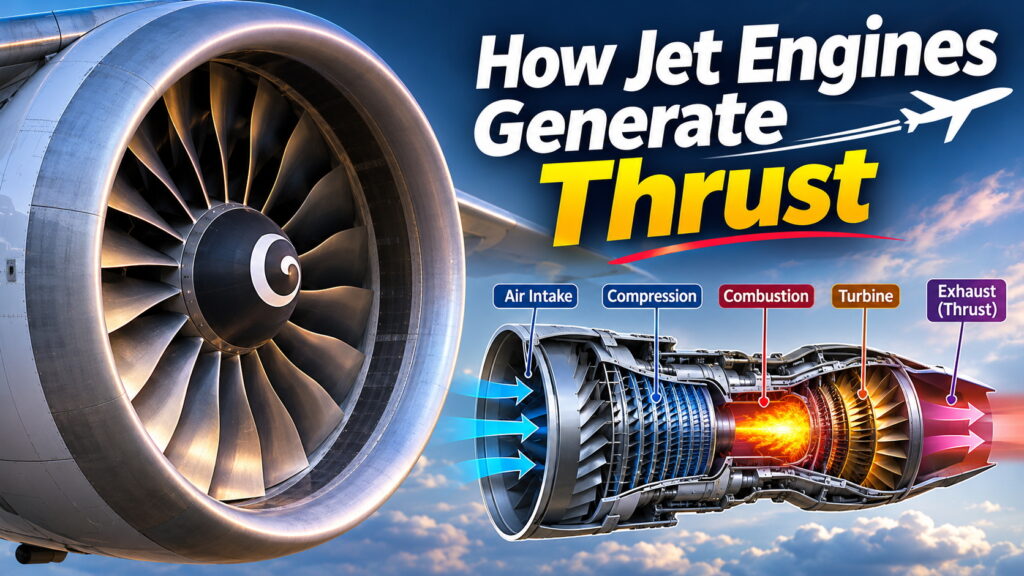
A typical gas-turbine jet engine operates through five major stages: intake, compression, combustion, turbine expansion, and exhaust.


1. Air Intake: Bringing Air Into the Engine
The process begins when air enters the engine through its front inlet. In a modern turbofan engine, a large rotating fan draws in and accelerates substantial quantities of air.
The airflow is divided into two main streams. One enters the engine core, where it undergoes compression and combustion. The other flows through the bypass duct around the core, contributing directly to thrust.
High-bypass turbofans use this large bypass airflow to improve propulsive efficiency and reduce noise compared with many older turbojet designs.
2. Compression: Increasing Air Pressure
Air entering the engine core passes through a series of compressor stages. Each stage contains rotating blades and stationary vanes that progressively increase air pressure.
This compressed air is then delivered to the combustion chamber. Higher pressure helps the engine convert fuel energy into useful mechanical power and thrust.
Modern compressors use carefully designed aerodynamic blade profiles to achieve high pressure ratios while limiting energy losses.
3. Combustion: Releasing Fuel Energy
Inside the combustion chamber, aviation fuel is injected into the compressed airflow and burned continuously.
The combustion process greatly increases the temperature of the gas. The resulting high-energy flow moves toward the turbine section.
Unlike a piston engine, a conventional jet engine maintains continuous combustion during normal operation rather than relying on separate combustion strokes.
4. Turbine: Driving the Engine
The hot gases pass through turbine stages, causing turbine blades to rotate. The turbine extracts part of the gas energy and transfers it through shafts to the compressor and, in a turbofan, the fan.
Turbine components operate under demanding conditions involving high temperatures, significant rotational speeds, and substantial mechanical loads.
Engineers use advanced superalloys, cooling systems, and protective coatings to help turbine components withstand these conditions.
5. Exhaust: Producing Forward Thrust
After passing through the turbine, the gases retain energy that allows them to accelerate through the exhaust nozzle.
The resulting jet of gas carries momentum backward. The corresponding reaction force pushes the engine forward.
In a modern turbofan, exhaust from the core provides only part of the total thrust. The bypass airflow accelerated by the fan supplies a major contribution, particularly in high-bypass commercial aircraft engines.
How a Modern Turbofan Engine Works


Modern commercial aircraft commonly use high-bypass turbofan engines. These engines combine a gas-turbine core with a large front fan.
The fan accelerates a large volume of air through the bypass duct while the core provides the power required to keep the fan turning.
Accelerating a larger mass of air by a smaller velocity difference generally produces better propulsive efficiency than accelerating a smaller mass of air to an extremely high speed.
The Science Behind Jet Propulsion
Engineers analyze jet engine thrust using the principle of conservation of momentum.
A simplified thrust relationship is:
Thrust ≈ Air Mass Flow Rate × (Exhaust Velocity − Flight Velocity)
This expression demonstrates that thrust depends on both the quantity of air being accelerated and the change in its velocity.
More complete calculations also account for fuel mass flow and differences between exhaust pressure and surrounding atmospheric pressure.
Different Types of Aircraft Gas-Turbine Engines
Turbojet Engines
Turbojets generate most of their thrust through a high-velocity exhaust stream. These engines were widely used during the early development of jet aviation.
Although suitable for certain high-speed applications, conventional turbojets are generally less fuel-efficient than high-bypass turbofans during typical subsonic commercial flight.
Turbofan Engines
Turbofans use a gas-turbine core to drive a fan that accelerates additional air around the engine core.
They power most modern jet airliners, including many aircraft produced by Boeing and Airbus.
High-bypass designs are particularly effective for commercial aviation because they combine substantial thrust with improved fuel efficiency and reduced noise.
Turboprop Engines
Turboprop engines use gas-turbine power primarily to turn a propeller rather than producing most of their thrust directly from exhaust gases.
These engines are especially well suited to regional aircraft operating over shorter routes at moderate flight speeds.
Why Modern Jet Engines Are So Efficient
Modern aircraft engines benefit from decades of advances in engineering, materials science, and aerodynamics.
- High bypass ratios: Move large quantities of air efficiently.
- Advanced compressors: Achieve high pressure ratios with reduced aerodynamic losses.
- Improved turbine materials: Withstand demanding temperatures and mechanical stresses.
- Electronic engine controls: Optimize fuel delivery and operating conditions.
- Advanced fan designs: Improve aerodynamic performance while managing weight and noise.
- Geared turbofan technology: Allows the fan and low-pressure turbine to operate at different rotational speeds in certain engines.
Can Jet Engines Operate at High Altitudes?
Yes. Jet engines are designed to function across a wide range of atmospheric conditions, including the lower air pressures encountered at cruising altitude.
At higher altitudes, reduced air density changes engine performance and the amount of air available for combustion. Engine controls and compressor systems help manage these conditions within the aircraft’s operating envelope.
Commercial aircraft often cruise at high altitude because reduced aerodynamic drag can improve overall flight efficiency.
Why Jet Engines Changed Aviation
The development of jet propulsion transformed global transportation. Jet-powered aircraft made it possible to travel faster, operate at higher altitudes, and connect distant cities more efficiently than many earlier aircraft designs.
Modern commercial engines continue this evolution through improvements in fuel consumption, reliability, durability, and environmental performance.
Conclusion
Jet engines generate thrust by accelerating air backward, creating a forward reaction force that propels an aircraft through the sky. Through intake, compression, combustion, turbine expansion, and exhaust, these machines convert chemical energy from fuel into useful propulsion.
Modern turbofan engines demonstrate how sophisticated engineering can improve this process by moving large volumes of air efficiently. As aerospace technology advances, aircraft engines will continue to evolve toward improved performance, efficiency, and sustainability.