


Views: 0
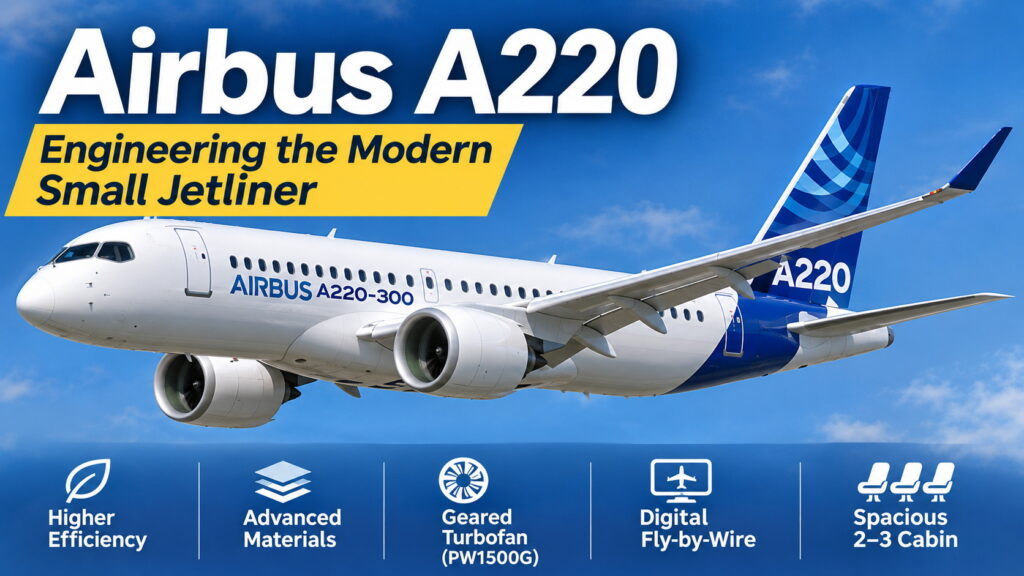
Airbus A220: Engineering the Modern Small Jetliner
The Airbus A220 represents a significant advancement in modern commercial aviation. Designed specifically for the 100–160-seat market, this small single-aisle jetliner combines lightweight materials, efficient aerodynamics, advanced flight controls, and innovative turbofan engines.
Originally developed by Bombardier as the CSeries, the aircraft entered commercial service in 2016 before joining the Airbus family in 2018. Its clean-sheet design allowed engineers to develop an aircraft optimized for regional and medium-haul operations rather than modifying an older platform.


Airbus A220 Technical Specifications
| Specification | A220-100 | A220-300 |
|---|---|---|
| Typical two-class seating | 100–120 | 120–150 |
| Maximum seating | 135 | 160 |
| Length | 35.0 m | 38.7 m |
| Wingspan | 35.1 m | 35.1 m |
| Height | 11.5 m | 11.5 m |
| Maximum takeoff weight | 63.7 tonnes | 70.9 tonnes |
| Published maximum range | 3,600 nm | 3,400 nm |
| Maximum operating Mach | 0.82 | 0.82 |
| Engine family | PW1500G | PW1500G |
Specifications are based on Airbus technical information. Performance depends on configuration, operating conditions and payload.
1. Clean-Sheet Airframe and Advanced Materials
Unlike aircraft developed from existing platforms, the A220 was engineered from the beginning around the requirements of the smaller single-aisle market.
Its structure incorporates advanced materials, including composite wings and aluminium-lithium alloys. These technologies help engineers balance structural strength, aircraft weight, fatigue resistance and operating efficiency.
The wings are designed to provide efficient lift while minimizing aerodynamic drag. Their shape and wingtip devices help reduce the energy lost through wingtip vortices.
Aerodynamic efficiency is especially important for smaller aircraft because lower drag reduces the thrust required during flight and contributes to lower fuel consumption.
2. Pratt & Whitney PW1500G Geared Turbofan Engines
One of the A220’s most important innovations is its Pratt & Whitney PW1500G geared turbofan engine.
In a conventional turbofan architecture, the fan and low-pressure turbine rotate at mechanically linked speeds. The geared turbofan adds a reduction gearbox that allows the fan to rotate more slowly while its driving turbine operates faster.
This helps both components operate closer to their preferred speeds, improving efficiency.
The PW1500G family features a large fan and a high bypass ratio, allowing a substantial amount of air to flow around the engine core. This contributes to lower fuel consumption and reduced noise.
Airbus states that the A220 offers approximately 25% lower fuel burn and carbon dioxide emissions per seat compared with previous-generation aircraft in its category. Actual savings depend on aircraft utilization, seating, route structure and operating conditions.
3. Digital Fly-by-Wire Flight Controls
The Airbus A220 incorporates advanced digital fly-by-wire flight controls. Instead of transmitting every pilot command through conventional mechanical linkages, electronic systems process control inputs and command the aircraft’s control surfaces.
Flight-control computers support stable and predictable aircraft handling while helping manage flight-envelope protections and system performance.
The aircraft’s modern cockpit integrates large digital displays, flight-management systems and electronic monitoring technology.
This integration helps pilots maintain situational awareness while reducing the complexity of managing aircraft systems.
4. Passenger Cabin Design


The A220 offers a passenger cabin designed around comfort and efficient use of space.
Its economy cabin typically features a 2–3 seating arrangement rather than the 3–3 configuration common on larger narrow-body aircraft. This means fewer middle seats, which can improve passenger comfort.
The aircraft also features large windows, wide seating options, generous overhead storage and modern lighting.
With a maximum cabin width of approximately 3.28 metres, the aircraft provides a spacious environment relative to its external dimensions.
The cabin demonstrates how passenger experience can be improved through careful fuselage geometry and interior engineering rather than simply increasing aircraft size.
5. Aerodynamic Performance and Route Flexibility


The A220 is capable of operating regional and longer-distance services, allowing airlines to match aircraft capacity with passenger demand.
The A220-100 is particularly suited to routes requiring fewer seats, while the longer A220-300 accommodates more passengers and may deliver better seat economics on routes with sufficient demand.
Both versions share important aircraft systems and engineering architecture, simplifying pilot training and fleet operations.
Its combination of range and capacity also allows airlines to consider routes that might be commercially challenging with larger narrow-body aircraft.
6. Engineering Challenges and Maintenance
Although the A220 incorporates advanced technologies, its operation has also highlighted the challenges of introducing new-generation propulsion systems.
The Pratt & Whitney PW1500G engine family has experienced durability and maintenance challenges affecting some airline fleets. These issues have contributed to engine inspections, unscheduled removals and temporary aircraft groundings.
Manufacturers have introduced technical improvements and maintenance measures to address these problems.
The experience illustrates an essential principle of aircraft engineering: efficiency improvements must be supported by long-term reliability, maintainability and sufficient spare-parts availability.
7. From Bombardier CSeries to Airbus A220


The origins of the Airbus A220 date back to Bombardier’s CSeries programme, officially launched in 2008.
The CS100 completed its first flight in September 2013, followed by the larger CS300 in February 2015.
SWISS became the launch operator when the CS100 entered commercial service in July 2016.
In 2018, the programme joined the Airbus aircraft family, and the CS100 and CS300 were renamed the A220-100 and A220-300.
The aircraft is assembled in Mirabel, Canada, and Mobile, Alabama, in the United States.
8. Why the Airbus A220 Matters
The A220 illustrates the benefits of designing an aircraft around a clearly defined market segment.
Instead of relying on a modified older airframe, its engineers integrated lightweight structures, efficient wings, geared turbofan propulsion, advanced flight controls and an optimized cabin into a single design.
For airlines, this offers flexibility in matching aircraft capacity to route demand. For passengers, it provides a modern cabin with an emphasis on space, comfort and quieter travel.
For the aviation industry, the A220 demonstrates how engineering improvements across several aircraft systems can collectively deliver substantial operational benefits.
Conclusion
The Airbus A220 is an important example of modern commercial aircraft engineering. Its clean-sheet design combines advanced materials, aerodynamic efficiency, digital systems and innovative engines in a highly capable small jetliner.
Despite maintenance challenges associated with its engines, the A220 has established itself as an important aircraft in the modern airline market.
Its development demonstrates that the future of commercial aviation depends not only on larger aircraft and longer routes, but also on carefully optimized designs that balance efficiency, operational flexibility and passenger comfort.