


Views: 0
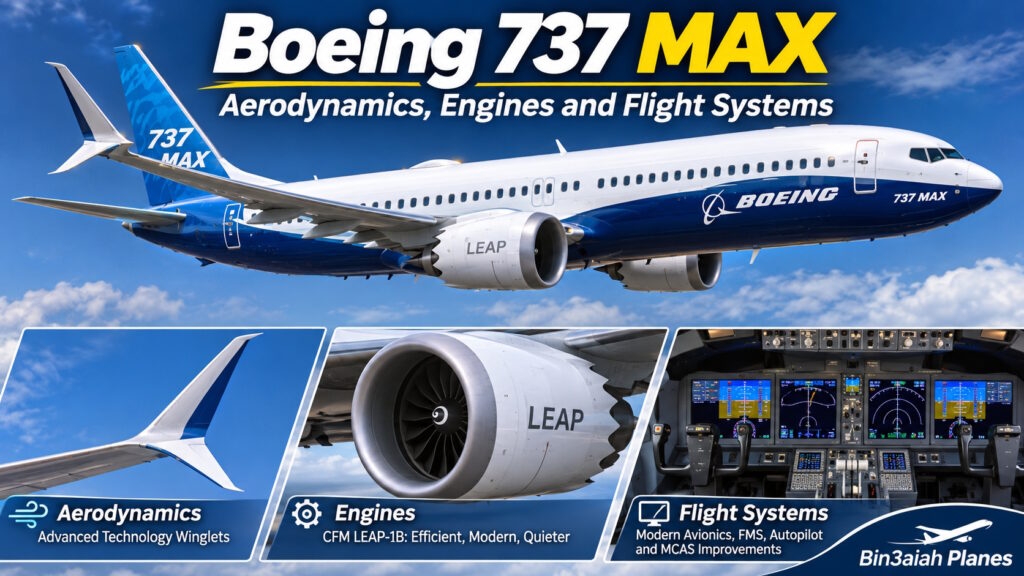
Boeing 737 MAX: Aerodynamics, Engines and Flight Systems
The Boeing 737 MAX represents a major evolution of one of the world’s most recognizable commercial aircraft families. Combining advanced aerodynamics, CFM LEAP-1B engines and upgraded flight systems, the aircraft was developed to improve fuel efficiency, operating economics and passenger comfort.


1. The Evolution of the Boeing 737 MAX
The Boeing 737 family first entered commercial service in 1968. Over subsequent decades, Boeing continuously improved the aircraft through new engines, aerodynamic modifications, increased capacity and improved avionics.
The 737 MAX program was launched in 2011 as the successor to the 737 Next Generation family.
The 737 MAX first flew on January 29, 2016, and entered airline service in 2017.
Unlike an entirely new aircraft design, the MAX builds upon the established 737 architecture. Its key engineering changes involve more efficient engines, redesigned winglets, improved aerodynamics and enhanced electronic systems.
2. Aerodynamics: Improving Lift and Reducing Drag
Aerodynamic efficiency plays a critical role in aircraft performance. The 737 MAX incorporates multiple refinements intended to reduce resistance as the airplane moves through the atmosphere.
Advanced Technology Winglets


One of the most recognizable features of the 737 MAX is its Advanced Technology winglet design.
Each wingtip incorporates an upward-pointing surface and a downward-pointing surface. These aerodynamic devices help reduce induced drag associated with wingtip vortices.
By improving the pressure distribution and airflow around the wingtips, the winglets effectively increase the aerodynamic efficiency of the wing.
According to Boeing, the Advanced Technology winglets can contribute up to approximately 2% fuel and CO2 emissions savings.
Improved Engine Nacelles
The 737 MAX uses larger engines than previous 737 generations. Their placement and nacelle integration required careful aerodynamic engineering because the aircraft has relatively limited ground clearance.
Boeing positioned the engines farther forward and higher relative to the wing compared with the previous generation.
This arrangement influenced the aircraft’s aerodynamic behavior and handling characteristics, particularly at elevated angles of attack.
Streamlined Rear Fuselage
Additional refinements to the rear fuselage help reduce drag. Boeing states that its aft-body aerodynamic improvements provide up to approximately 1% additional fuel and emissions savings.
3. CFM LEAP-1B Engines: The Heart of the 737 MAX


The Boeing 737 MAX is powered by two CFM International LEAP-1B high-bypass turbofan engines.
The LEAP-1B was developed specifically for the 737 MAX and incorporates advanced materials, improved aerodynamics and modern combustion technology.
Advanced Engine Technology
- Composite fan blades: Advanced materials help reduce weight while maintaining structural strength.
- Ceramic matrix composites: Heat-resistant components allow selected engine sections to operate efficiently at high temperatures.
- Improved combustion: Advanced combustor technology helps manage fuel efficiency and emissions.
- High bypass ratio: A larger proportion of airflow bypasses the engine core, improving propulsive efficiency.
- Noise-reduction technology: Engine and nacelle refinements help reduce noise compared with previous designs.
Fuel Efficiency
Boeing advertises approximately 20% lower fuel use and associated CO2 emissions for the 737 MAX compared with the aircraft generations used in its comparison.
The actual benefit depends on flight distance, payload, aircraft configuration and operating conditions.
4. Flight Deck and Avionics Technology

The Boeing 737 MAX flight deck combines modern electronic displays with an operating philosophy familiar to pilots of previous 737 generations.
Four large 15-inch displays present essential flight, engine, navigation and aircraft-system information.
Flight Management System
The Flight Management System helps pilots manage navigation routes, aircraft performance and flight planning.
It integrates information from navigation equipment and aircraft sensors to support efficient flight operations.
Autopilot and Flight Director
The autopilot and flight director support pilots in controlling the aircraft’s flight path, altitude, speed and navigation according to selected operating modes.
These functions can reduce pilot workload during appropriate phases of flight, while requiring continuous crew monitoring.
Digital Flight Displays
The cockpit displays provide important information including airspeed, altitude, attitude, navigation, engine performance and system status.
They improve information presentation and support pilot situational awareness.
5. Aircraft Flight Control Systems
Despite its modern avionics, the Boeing 737 MAX is not a full fly-by-wire aircraft.
Its primary flight-control architecture retains mechanical control inputs and hydraulically powered surfaces, while incorporating electronic functions including fly-by-wire spoilers.
Primary Flight Controls
- Ailerons: Help control rolling motion around the aircraft’s longitudinal axis.
- Elevators: Control pitch motion around the lateral axis.
- Rudder: Controls yaw motion around the vertical axis.
- Horizontal stabilizer: Provides pitch-trim adjustment.
Secondary Flight Controls
Flaps and slats increase wing lift during takeoff and landing, allowing the aircraft to operate at lower speeds.
Spoilers help manage lift and drag, support roll control and assist with deceleration after landing.
6. MCAS: Engineering, Safety and Software Updates
One of the most widely discussed systems on the 737 MAX is the Maneuvering Characteristics Augmentation System (MCAS).
MCAS was introduced to modify aircraft handling characteristics under specific elevated-angle-of-attack conditions.
The original system became a central safety concern following two fatal accidents:
- Lion Air Flight 610: October 29, 2018.
- Ethiopian Airlines Flight 302: March 10, 2019.
Investigations identified serious deficiencies involving erroneous angle-of-attack sensor data, MCAS behavior, system design, training and regulatory oversight.
The accidents led to the worldwide grounding of the 737 MAX fleet in 2019.
MCAS Safety Improvements
Before the aircraft returned to service, Boeing implemented changes reviewed and required by aviation regulators.
- MCAS uses information from both angle-of-attack sensors for validation.
- MCAS is inhibited when the sensors disagree beyond the specified threshold.
- Repeated MCAS stabilizer commands are prevented during the same elevated-angle-of-attack event.
- MCAS command authority is limited.
- Flight-control software and pilot training procedures were updated.
The United States Federal Aviation Administration authorized the modified 737 MAX to return to service in November 2020, following extensive technical review.
The MCAS experience became an important case study in system redundancy, human factors, certification and aviation safety engineering.
7. Boeing 737 MAX Family and Specifications
The 737 MAX family includes four principal passenger variants with different fuselage lengths and passenger capacities.
| Specification | MAX 7 | MAX 8 | MAX 9 | MAX 10 |
|---|---|---|---|---|
| Length | 35.6 m | 39.5 m | 42.1 m | 43.8 m |
| Wingspan | 35.9 m | 35.9 m | 35.9 m | 35.9 m |
| Maximum seats | 172 | 210 | 220 | 230 |
| Advertised range | 3,800 nmi | 3,500 nmi | 3,300 nmi | 3,100 nmi |
| Engine type | 2 × CFM LEAP-1B | |||
Note: Specifications are approximate manufacturer figures. Maximum seating differs from typical airline layouts, and certification or commercial-service status varies by variant.
8. Advantages of the Boeing 737 MAX
- Improved fuel efficiency: Modern engines and aerodynamic upgrades reduce fuel consumption.
- Lower emissions: Reduced fuel burn lowers CO2 emissions per comparable flight.
- Improved range: Enables airlines to operate a wider selection of medium-haul routes.
- Modern cockpit: Large digital displays and advanced avionics support flight operations.
- Operational commonality: Retains many characteristics of earlier Boeing 737 aircraft.
- Passenger comfort: Modern cabin configurations can offer improved lighting and interior design.
9. Engineering Challenges and Limitations
The 737 MAX also demonstrates the limitations of continuously modernizing an existing aircraft platform.
- Airframe constraints: The original 737 configuration imposes restrictions on engine integration and ground clearance.
- Flight-control complexity: New aerodynamic characteristics required careful integration with existing control architecture.
- Safety certification: The program demonstrated the consequences of weaknesses in system safety assessment and oversight.
- Manufacturing quality: Production consistency, inspection procedures and quality assurance remain important considerations.
10. The Future of the Boeing 737 MAX
The 737 MAX remains an important aircraft family for global short- and medium-haul aviation.
Future development and improvements must balance fuel efficiency, operating economics, safety, regulatory compliance and manufacturing quality.
Advances in materials, propulsion efficiency, digital monitoring and aircraft manufacturing may influence how the existing family evolves and how Boeing approaches future commercial aircraft.
Conclusion
The Boeing 737 MAX illustrates how aerodynamic refinement, advanced propulsion and updated avionics can significantly improve an established commercial aircraft design.
Its split-tip winglets, LEAP-1B engines and modern cockpit technology represent important engineering achievements.
At the same time, the aircraft’s development history reinforces a fundamental lesson in aerospace engineering: improvements in performance and efficiency must be accompanied by rigorous system design, testing, certification and operational safety.
References and Further Reading
- Boeing — 737 MAX Family
- Boeing — 737 MAX By Design
- FAA — Boeing 737 MAX Technical Documents
- Boeing — Flight-Control Software Updates
Image credits and license details are available on the respective Wikimedia Commons file pages. Retain required attribution when reusing photographs.
Explore more aviation technology, aircraft engineering and aerospace stories at Bin3aiah Planes.