


Views: 0
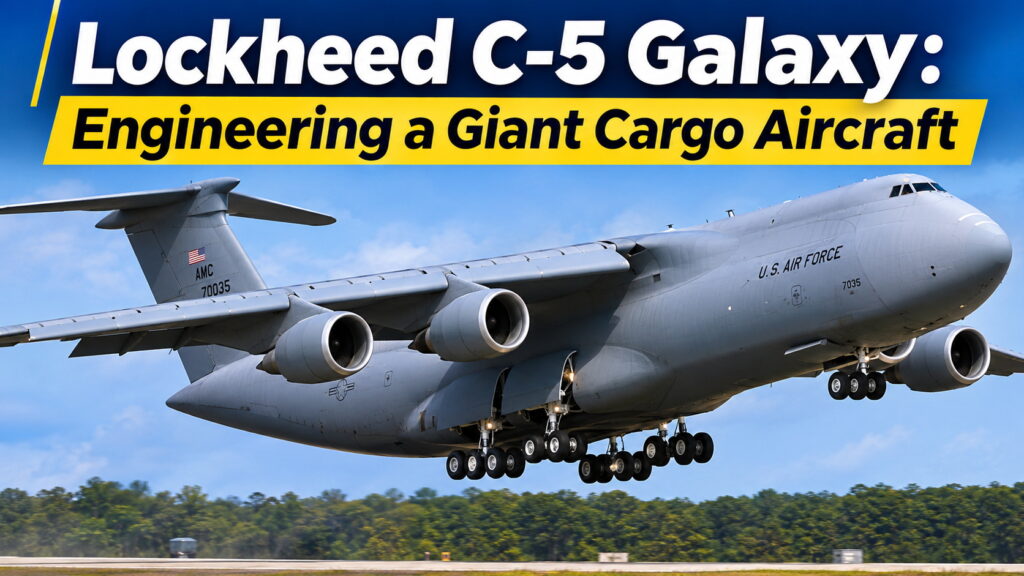
Lockheed C-5 Galaxy: Engineering a Giant Cargo Aircraft
The Lockheed C-5 Galaxy is one of the largest military transport aircraft ever built. Designed to carry enormous equipment, vehicles, helicopters, and personnel across continents, this extraordinary aircraft demonstrates what is possible when engineering is pushed to its limits.


Developed by Lockheed during the 1960s, the Galaxy entered U.S. Air Force service in 1970. Its giant cargo compartment, four turbofan engines, specialized landing gear, and innovative loading system established it as a cornerstone of American strategic airlift.
1. Engineering an Aircraft of Extraordinary Size
The C-5 Galaxy was developed to solve a difficult transportation challenge: moving extremely heavy and oversized military equipment over intercontinental distances.
Engineers designed an aircraft with a high-mounted wing, a distinctive T-tail, an exceptionally large fuselage, and four powerful engines. Every major component was developed around the demands of heavy cargo transportation.
The modernized C-5M Super Galaxy measures approximately 75.3 metres long and has a wingspan of 67.89 metres. Its maximum takeoff weight reaches 381,024 kilograms.
Lockheed C-5M Super Galaxy Specifications
| Specification | Details |
|---|---|
| Manufacturer | Lockheed Martin |
| Aircraft type | Strategic heavy transport |
| Original operational delivery | 1970 |
| Length | 75.3 m |
| Wingspan | 67.89 m |
| Height | 19.84 m |
| Maximum takeoff weight | 381,024 kg |
| Maximum allowable payload | 127,460 kg |
| Engines | Four General Electric F138 turbofans |
| Thrust per engine | 51,250 lbf |
| Speed | Approximately 833 km/h |
| Landing gear wheels | 28 |
| Cargo pallet positions | 36 |
2. An Enormous Cargo Compartment
The C-5 Galaxy’s cargo compartment is one of its defining engineering achievements. Measuring approximately 43.8 metres long, 5.79 metres wide, and 4.11 metres high, it can accommodate large vehicles and equipment that would be impractical to transport aboard smaller aircraft.


The aircraft can transport military trucks, armored vehicles, helicopters, palletized supplies, and numerous other types of oversized cargo.
Its loading system includes reinforced flooring, cargo-handling equipment, and tie-down provisions designed to secure heavy loads during flight.
3. The Giant Nose That Opens Upward
One of the most recognizable features of the C-5 Galaxy is its unusual nose-loading mechanism.
Unlike conventional cargo aircraft that rely primarily on rear loading doors, the Galaxy can raise its entire forward nose section to expose a full-width cargo opening.


The aircraft also has a large rear cargo opening, enabling ground crews to load and unload equipment from both ends.
This drive-through arrangement reduces cargo-handling time and simplifies the movement of vehicles that cannot easily turn around inside an aircraft.
4. The Incredible 28-Wheel Landing Gear
Supporting an aircraft with a maximum takeoff weight exceeding 380 tonnes requires an exceptionally strong landing gear system.
The C-5M uses five landing gear assemblies with a total of 28 wheels, distributing the aircraft’s weight across multiple contact points.
Its landing gear also incorporates a feature known as kneeling. Hydraulic mechanisms allow the aircraft to lower its fuselage closer to the ground while parked.
This lowers the cargo floor and reduces loading ramp angles, making the movement of heavy equipment safer and more efficient.
By combining a specialized landing gear design with front and rear ramps, engineers created an aircraft capable of handling unusually large cargo loads without depending entirely on external lifting equipment.
5. Four Powerful Turbofan Engines
The original C-5 Galaxy used General Electric TF39 turbofan engines. These engines were developed for high-thrust military transportation requirements.
The modern C-5M Super Galaxy uses four General Electric F138 engines, based on the CF6 commercial engine family.


Each F138 engine produces approximately 51,250 pounds of thrust. The modernization provides improved performance, reliability, and fuel efficiency compared with the aircraft’s older propulsion system.
These engines help the aircraft maintain its long-distance strategic airlift capability while transporting exceptionally heavy equipment.
6. How the C-5 Galaxy Flies Across Continents
Transporting massive cargo over long distances requires careful management of fuel, weight distribution, aircraft performance, and operational planning.
The C-5M can travel approximately 4,800 nautical miles while carrying 120,000 pounds of cargo, according to the U.S. Air Force’s published operating figures.
The aircraft also supports aerial refueling, enabling longer missions without landing solely to replenish fuel.


The combination of enormous cargo capacity, long-distance performance, and aerial refueling makes the Galaxy valuable for moving important equipment between distant military bases.
7. From the C-5A to the C-5M Super Galaxy
The Galaxy has undergone several major upgrades since its original introduction.
C-5A Galaxy
The original production model introduced the aircraft’s enormous cargo capacity and innovative loading system into U.S. Air Force operations in 1970.
C-5B Galaxy
This improved production version incorporated numerous modifications aimed at enhancing reliability, maintainability, and overall performance.
C-5C Galaxy
Two aircraft were modified to transport specialized oversized space-related cargo.
C-5M Super Galaxy
The C-5M modernization introduced new engines, updated avionics, and improved reliability systems. Its integrated maintenance diagnostics system helps technicians identify and address technical issues more efficiently.
8. Why the Galaxy Remains Important
The true significance of the C-5 Galaxy is not simply its extraordinary size. Its engineering allows very large cargo to be transported over enormous distances with relatively efficient ground handling.
For strategic military transportation, this capability can reduce the need to dismantle equipment or move it through multiple smaller aircraft.


Beyond military deployments, large strategic transport aircraft can also support humanitarian and disaster-response operations by carrying equipment, relief supplies, and essential transportation assets.
Conclusion
The Lockheed C-5 Galaxy remains an outstanding example of large-scale aerospace engineering. Its high-wing structure, enormous cargo compartment, upward-opening nose, 28-wheel landing gear, and powerful turbofan engines combine to create one of aviation’s most capable heavy transport aircraft.
With the C-5M Super Galaxy modernization, this remarkable design continues to demonstrate how advanced engineering can extend the capabilities and operational life of a historic aircraft.
Sources and Image Credits
- U.S. Air Mobility Command – C-5 Galaxy Fact Sheet
- U.S. Air Force – C-5 Technical Information
- Wikimedia Commons – C-5M at Eglin AFB
- Wikimedia Commons – C-5M Cargo Bay
- Wikimedia Commons – C-5 Cargo Loading
- Wikimedia Commons – C-5M Engines
- Wikimedia Commons – C-5M 87-0035
- Wikimedia Commons – C-5M at RAF Lakenheath


