


Views: 0
Northrop Grumman B-2 Spirit: Flying-Wing Stealth Design


8
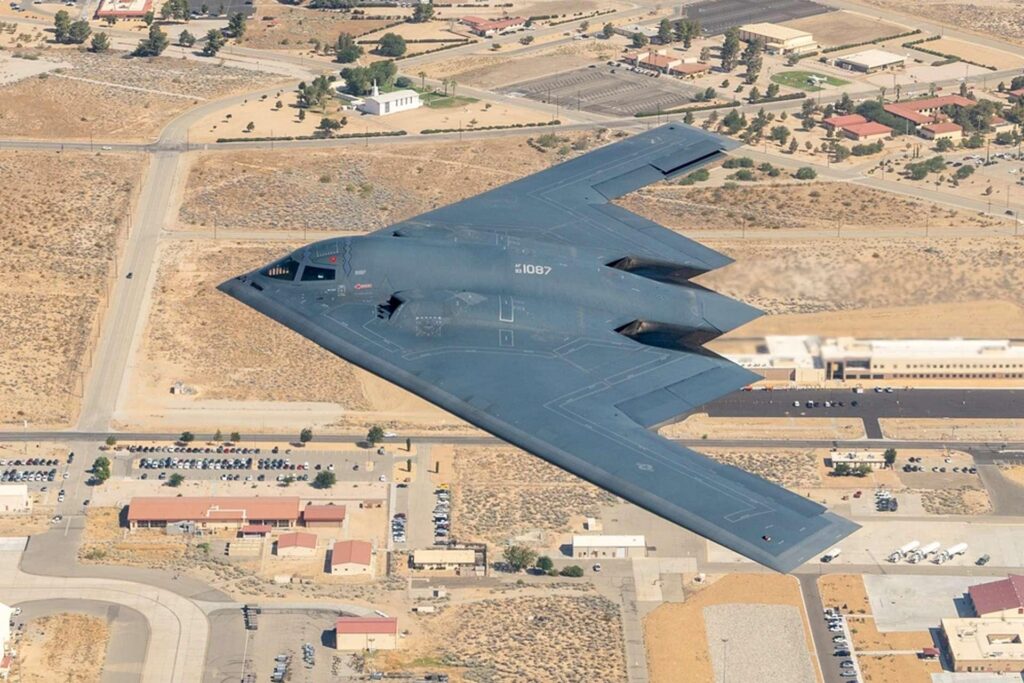
The Northrop Grumman B-2 Spirit is one of the most distinctive military aircraft ever built. Its enormous wingspan, tailless silhouette, advanced materials, and low-observable technologies make it a landmark achievement in aerospace engineering.
Developed during the Cold War, the B-2 combines a highly efficient flying-wing design with sophisticated flight controls and the ability to deliver conventional or nuclear weapons over intercontinental distances.
Unlike traditional bombers, the B-2 was designed around a central engineering challenge: how to carry a substantial payload across vast distances while minimizing the chances of detection, tracking, and interception by advanced air-defense systems.
B-2 Spirit: Technical Specifications
| Manufacturer | Northrop Grumman |
| Aircraft type | Strategic stealth bomber |
| First flight | July 17, 1989 |
| First operational delivery | December 17, 1993 |
| Initial operational capability | April 1997 |
| Crew | 2 |
| Wingspan | 52.12 m (172 ft) |
| Length | 20.9 m (69 ft) |
| Height | 5.1 m (17 ft) |
| Engines | 4 × General Electric F118-GE-100 turbofans |
| Maximum takeoff weight | 152,634 kg |
| Unrefueled range | Approximately 6,000 nautical miles |
| Service ceiling | 50,000 ft |
| Maximum speed | High subsonic |
| Weapons | Conventional and nuclear |
| Production | 21 aircraft built |
Specifications from the U.S. Air Force and Northrop Grumman. Published payload figures vary by configuration and source.

U.S. Air Force
+2
1. The Origins of the B-2 Spirit
During the 1970s and 1980s, increasingly sophisticated radar networks and surface-to-air missiles challenged the survivability of conventional strategic bombers.
The United States launched the Advanced Technology Bomber program to develop an aircraft that could penetrate heavily defended airspace while retaining the range and payload required for strategic missions.
Northrop’s engineering team drew on decades of flying-wing research, including the earlier YB-35 and YB-49 experimental bombers.
The resulting aircraft represented a dramatic departure from conventional bomber designs.
Its important milestones included:
- 1981: Northrop selected for the Advanced Technology Bomber program.
- November 22, 1988: First public unveiling in Palmdale, California.
- July 17, 1989: Maiden flight.
- December 17, 1993: First operational delivery.
- April 1997: Initial operational capability.
- 1999: Combat debut during Operation Allied Force.
Although early plans called for a much larger fleet, the end of the Cold War, changing strategic priorities, and the aircraft’s high cost ultimately limited production to 21 examples.
Air Force Museum
+2
2. Why the Flying-Wing Design Matters


The B-2’s most recognizable feature is its flying-wing configuration.
Most aircraft have a distinct fuselage, horizontal stabilizers, and a vertical tail. The B-2 largely integrates the fuselage and wings into one continuous lifting surface.
This configuration provides several engineering advantages.
Reduced radar reflections
Traditional aircraft include numerous structural intersections, protruding surfaces, and vertical components that can strongly reflect radar signals.
The B-2 minimizes many of those features through its carefully shaped exterior.
Improved aerodynamic efficiency
A flying wing can provide a favorable lift-to-drag ratio, supporting efficient long-range cruising when properly designed.
This is particularly valuable for a strategic aircraft that may fly thousands of kilometers before reaching its destination.
Internal storage
The broad center section accommodates fuel, engines, crew systems, and internal weapons bays without relying on large external stores.
Complex flight control
Removing conventional tail surfaces introduces stability and control challenges.
The B-2 addresses these challenges with computerized flight-control systems that continuously command its aerodynamic control surfaces.
The aircraft demonstrates how aerodynamics, digital control, and low-observable design can work together rather than function as isolated technologies.
3. How the B-2’s Stealth Technology Works


10
Stealth does not make the B-2 completely invisible to radar. Instead, it reduces multiple signatures that detection and targeting systems rely upon.
Radar signature reduction: The aircraft’s geometry helps redirect radar energy away from a receiving antenna. Special materials and coatings further reduce selected radar reflections.
Infrared signature management: Its engines are embedded within the wing, and the exhaust system is designed to help manage the aircraft’s thermal signature.
Internal weapons carriage: Carrying weapons inside the airframe preserves the aircraft’s carefully shaped exterior during flight.
Surface integration: The design carefully manages panel interfaces, openings, and external details that might otherwise interfere with low-observable performance.
Reduced visual and acoustic signatures: The aircraft incorporates features that complement its radar stealth, although it is neither silent nor visually invisible.
The B-2’s survivability results from this combination of techniques, rather than from any single coating or unusual shape. Many specific details remain classified.
Air Force Global Strike Command
+1
4. Engines, Range, and Flight Performance
The B-2 uses four General Electric F118-GE-100 turbofan engines, each producing approximately 17,300 pounds of thrust.
Mounted inside the aircraft rather than in conventional external pods, these engines support its aerodynamic and stealth requirements.
The bomber is designed for high-subsonic flight, prioritizing endurance, payload, and survivability rather than supersonic speed.
Its published unrefueled range is approximately 6,000 nautical miles, or 11,100 kilometers. Aerial refueling allows much longer missions and gives the aircraft global reach.
Northrop Grumman
+1
5. Cockpit and Flight-Control Technology


Despite its enormous size and technical complexity, the B-2 operates with a crew of just two: a pilot and a mission commander.
A digital fly-by-wire flight-control system translates pilot commands into coordinated movements of the aircraft’s control surfaces.
The system is particularly important because the B-2 does not have the conventional vertical tail surfaces used by most airplanes.
Integrated navigation, communications, radar, and mission-management systems help the crew conduct demanding long-range operations.
On extended missions, crew workload management and aerial refueling are essential components of the aircraft’s operational capability.
6. Weapons and Strategic Capabilities
The B-2 was developed to carry both nuclear and conventional weapons.
Its internal weapons bays allow it to transport significant ordnance without compromising the aircraft’s external configuration.
Its publicized capabilities include precision-guided conventional weapons and nuclear gravity bombs. The aircraft is also associated with the GBU-57 Massive Ordnance Penetrator, a specialized conventional weapon intended for deeply buried and hardened targets.
Its operational value comes from the combination of long range, substantial payload, precision delivery, and reduced observability.
The B-2 therefore serves two broad strategic roles: conventional long-range strike and nuclear deterrence.
7. Operational History

Since entering service, the B-2 has participated in several major military operations.
During the Kosovo conflict in 1999, the aircraft conducted its first combat missions. Subsequent operations included Afghanistan in 2001 and Iraq in 2003.
These missions demonstrated the usefulness of a bomber capable of departing from its home base, traveling intercontinental distances, releasing precision weapons, and returning after aerial refueling.
Some missions have lasted more than 30 hours, placing substantial demands on crews, maintenance teams, and support aircraft.
Air Force Museum
The B-2 has also continued serving as part of the United States’ strategic deterrence capability, with modernization programs intended to keep its communications, mission systems, and weapons integration operationally relevant.
8. Maintenance and the Cost of Stealth
The B-2’s advanced design presents unusual maintenance challenges.
Its external surfaces require careful inspection and repair because the condition of low-observable materials affects mission performance.
Maintenance also includes structural inspections, component replacement, systems testing, and software updates.
In June 2026, the Spirit of Ohio returned to operations after programmed depot maintenance that addressed structural condition, aging components, and low-observable performance.
stratcom.mil
The B-2 was also exceptionally expensive to develop and produce. The U.S. Air Force lists an approximate unit cost of $1.157 billion in fiscal-1998 constant dollars, a figure that should not be mistaken for its present-day replacement cost.
U.S. Air Force
9. The B-2 Spirit and the B-21 Raider
B-2 Spirit
First flown in 1989. A large, two-person strategic stealth bomber.


B-21 Raider
First flown in 2023. A newer stealth bomber designed for evolving operational requirements.
The B-2 helped establish the flying-wing configuration as a practical design for long-range stealth aircraft.
Its successor, the B-21 Raider, continues the general flying-wing approach while incorporating newer manufacturing, computing, and low-observable technologies.
The B-2 remains an important part of the U.S. bomber fleet during the transition toward the next generation of strategic aircraft.
10. Why the B-2 Spirit Is an Aerospace Milestone
The B-2 is significant for more than its military role.
Its development pushed forward several interconnected engineering disciplines: computational aerodynamics, composite structures, computerized flight controls, low-observable materials, and systems integration.
The flying-wing configuration had existed long before the B-2, but the Spirit demonstrated how advances in computing and manufacturing could make the concept practical for a sophisticated operational aircraft.
Its influence remains visible in contemporary aircraft research and newer stealth designs.
Conclusion
The Northrop Grumman B-2 Spirit stands among the most remarkable aircraft of the modern aviation era. Its flying-wing configuration is not simply an unusual appearance; it is fundamental to the way the aircraft combines aerodynamic performance, long-range capability, and stealth.
From its Cold War origins to its continued service, the B-2 illustrates how ambitious engineering can transform aircraft design and influence future generations of aviation technology.
SEO Details — WordPress
SEO Title
B-2 Spirit: Flying-Wing Stealth Design ExplainedURL Slug
northrop-grumman-b-2-spirit-stealth-bomberMeta Description
Explore the Northrop Grumman B-2 Spirit stealth bomber, its flying-wing design, radar evasion, engines, specifications, and aviation history.
CopyFocus Keyword
Northrop Grumman B-2 SpiritSuggested Category
Military Aircraft / Strategic BombersWordPress Tags
B-2 Spirit, Northrop Grumman, Stealth Bomber, Flying Wing, Military Aviation, Strategic Bomber, Aircraft Engineering, Stealth Technology, US Air Force, Aviation History, B-21 Raider, Jet Aircraft
Copy tags
Featured Image Recommendation


Alt text: Northrop Grumman B-2 Spirit stealth bomber demonstrating its distinctive flying-wing design in flight.
For reusable official imagery, see the U.S. Air Force B-2 photo and check the image’s credit and usage terms before publishing.
Official Sources and Further Reading
- U.S. Air Force — B-2 Spirit Fact Sheet
- Northrop Grumman — Technical Details
- National Museum of the U.S. Air Force — B-2 History
The article is ready for editorial use on planes.bin3aiah.net. The next publishing step would be converting it into one copy-ready WordPress HTML block, with embedded images, source links, and dedicated video placements.