


Views: 7
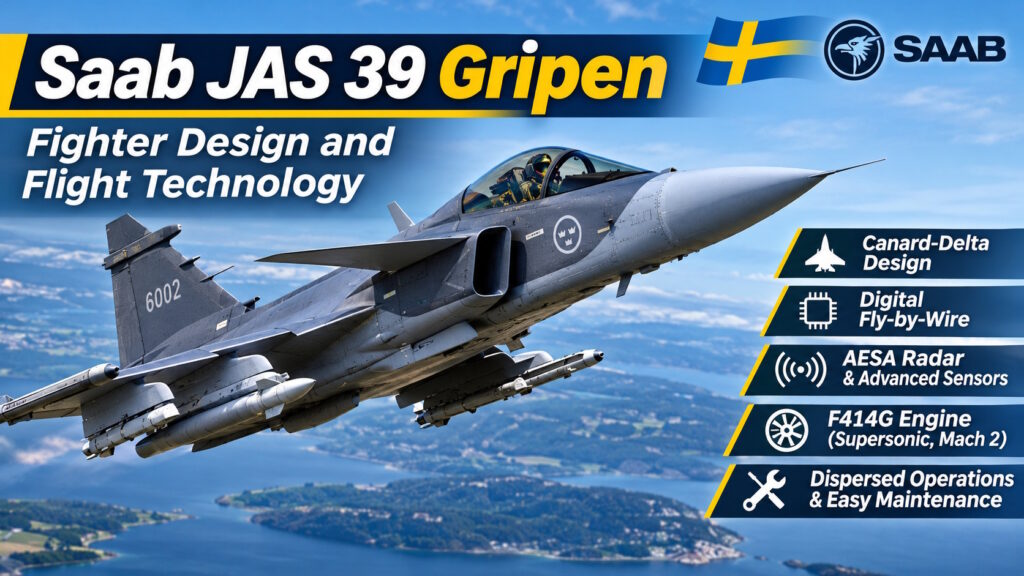
Saab JAS 39 Gripen: Fighter Design and Flight Technology
The Saab JAS 39 Gripen is one of the most distinctive modern fighter aircraft, combining advanced aerodynamics, supersonic performance, digital flight controls, sophisticated sensors and efficient operational support.
Developed by Swedish aerospace manufacturer Saab, the Gripen was designed to perform air defense, ground attack and reconnaissance missions while maintaining the flexibility to operate from dispersed airfields and suitably prepared road bases.


1. The History Behind the Saab Gripen
The Gripen program emerged from Sweden’s requirement to replace aging combat aircraft, including the Saab 35 Draken and Saab 37 Viggen.
Its first prototype flew on 9 December 1988, and the Gripen subsequently entered Swedish Air Force service during the 1990s.
The name JAS represents three Swedish mission categories:
- Jakt: Fighter and air-defense missions.
- Attack: Air-to-ground operations.
- Spaning: Reconnaissance missions.
Instead of developing separate aircraft for each role, Sweden pursued a versatile platform capable of performing multiple missions with different equipment and weapons configurations.
2. Aerodynamic Design: Delta Wings and Canards
One of the Gripen’s most recognizable engineering features is its close-coupled canard-delta wing configuration.
The main delta wing provides a large swept aerodynamic surface suited to high-speed flight. Smaller movable surfaces, known as canards, are positioned ahead of the main wing.


Why Use a Delta Wing?
Delta wings offer important advantages for supersonic aircraft, including structural efficiency, high-speed aerodynamic performance and useful internal space for aircraft systems.
However, delta wings can also create aerodynamic challenges at lower speeds. The Gripen addresses these through careful aerodynamic integration, canard foreplanes and computerized flight controls.
The Role of Canards
The Gripen’s canards help control pitch and influence airflow around the main wing. Their close-coupled positioning can help maintain lift and maneuvering performance at demanding angles of attack.
The combination provides a balance between high-speed capability, maneuverability and controllability.
3. Digital Fly-by-Wire Flight Controls
Unlike aircraft that depend primarily on mechanical connections between the pilot’s controls and aerodynamic surfaces, the Gripen uses an advanced digital fly-by-wire flight-control system.
When the pilot moves the control stick, computers interpret the command and calculate how the aircraft’s control surfaces should respond.
The system continuously accounts for changing flight conditions and coordinates the surfaces to achieve the requested response.
Advantages of Fly-by-Wire
- Precise control during demanding maneuvers.
- Improved handling across different flight conditions.
- Continuous aerodynamic stabilization.
- Flight-envelope protection.
- Reduced pilot workload.
The Gripen uses an intentionally relaxed-stability aerodynamic design. Its computerized flight-control system plays a vital role in keeping the aircraft stable and controllable.
4. Jet Engine and Supersonic Performance
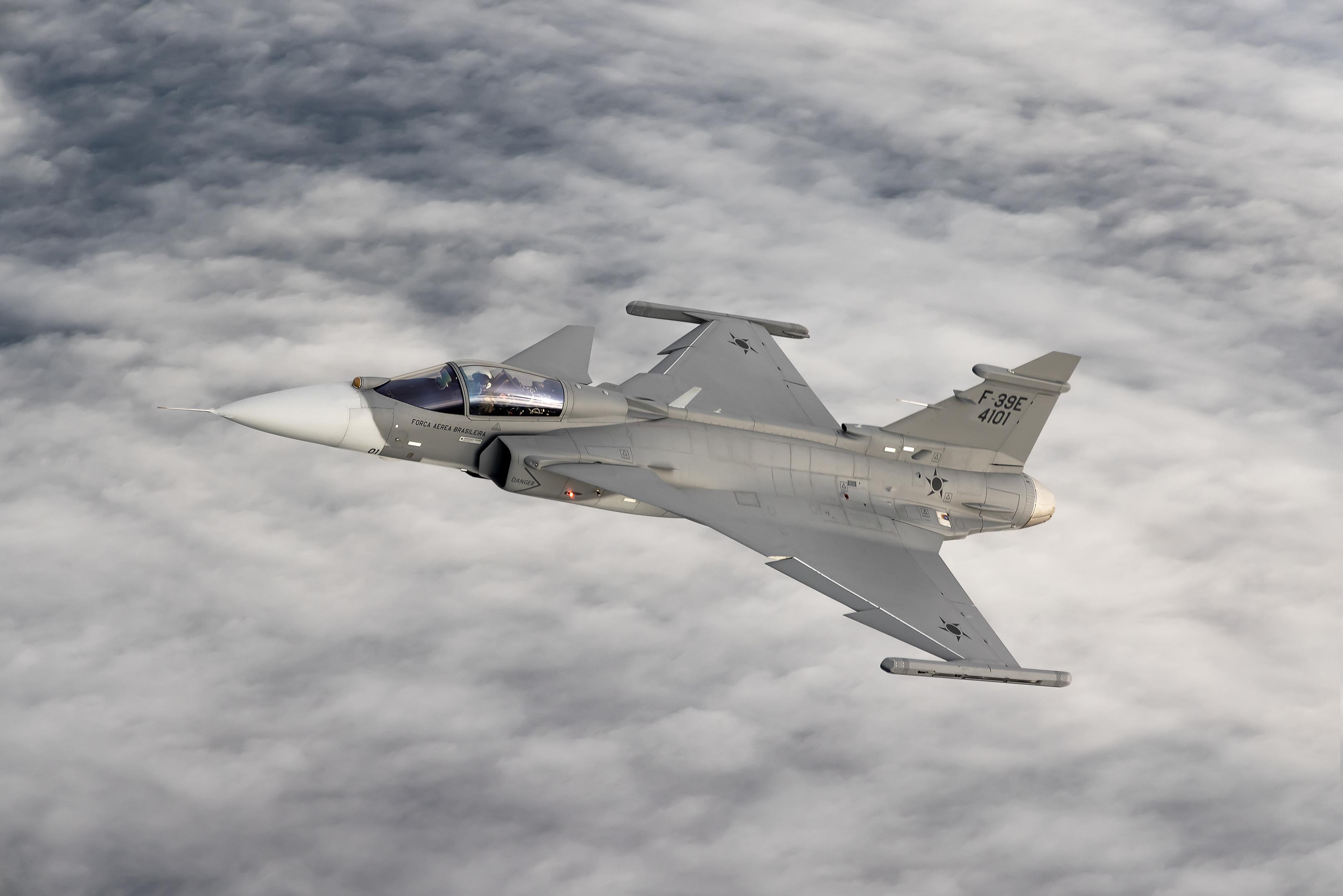
The Gripen family uses a single afterburning turbofan engine. The engine differs between generations.
The Gripen C/D uses the Volvo RM12, developed from the General Electric F404 engine family.
The newer Gripen E uses the more powerful General Electric F414G engine, producing approximately 98 kilonewtons of maximum thrust with afterburner.

How an Afterburner Works
An afterburner injects additional fuel into the hot exhaust stream behind a jet engine’s turbine. Burning this fuel produces additional thrust, allowing rapid acceleration and high-speed flight.
The trade-off is substantially increased fuel consumption, making afterburner use most appropriate for situations requiring additional performance.
According to Saab’s published technical information, the Gripen E has a maximum speed of approximately Mach 2, depending on operating conditions.
5. Advanced Radar and Sensor Technology
The Gripen E incorporates an advanced sensor suite designed to help pilots detect, track and understand activity in the surrounding airspace.
Active Electronically Scanned Array Radar
The Gripen E uses an AESA radar capable of electronically steering its radar beam. This enables rapid scanning and tracking without relying on conventional mechanical beam steering alone.
Infrared Search and Track
The aircraft’s infrared search-and-track system detects thermal signatures from other objects, providing a passive sensing capability that complements radar.
Electronic Warfare
Electronic warfare technology supports threat detection, signal analysis and countermeasures. It can help the aircraft recognize potentially hostile electromagnetic activity and respond with appropriate defensive or offensive electronic measures.
Sensor Fusion
Information from radar, infrared sensors, electronic warfare equipment and networked sources can be combined into a more complete picture of the tactical environment.
This reduces the need for pilots to interpret every sensor independently.
6. Modern Cockpit and Pilot Interface
The Gripen E features a modern cockpit designed to present complex mission information in a clear, usable format.
A prominent feature is its Wide Area Display, which integrates multiple types of information within a large configurable screen.
The cockpit can present navigation information, aircraft status, sensor tracks, tactical data and weapon information according to mission requirements.
Advanced human-machine interaction helps the pilot focus on decisions instead of manually managing numerous separate systems.
7. Short-Runway Operations and Aircraft Maintenance
One of the most important design principles behind the Gripen is operational flexibility.
Sweden developed a dispersed-airbase philosophy that enables military aircraft to operate away from large, centralized airbases.
The Gripen’s support concept emphasizes accessibility, maintainability and efficient turnaround.
Saab states that the Gripen E can complete a typical air-to-air refueling and rearming turnaround in approximately 15 minutes under suitable operational conditions with a limited ground crew.
These capabilities can be especially valuable when air forces need to distribute aircraft across multiple operating locations.
8. Gripen Variants and Evolution
Gripen A/B
The first operational generation established the basic aerodynamic configuration and multirole concept. The A was the single-seat aircraft, while the B provided a two-seat configuration.
Gripen C/D
The C/D generation introduced significant improvements to avionics, communications, compatibility with international operations and in-flight refueling capability.
Gripen E/F
The newer E/F generation incorporates more powerful propulsion, additional internal fuel, upgraded radar and sensors, advanced electronic warfare systems and a redesigned avionics architecture.
The Gripen E is a single-seat fighter, while the Gripen F is the two-seat version.
9. Saab Gripen E Technical Specifications
| Specification | Gripen E |
|---|---|
| Manufacturer | Saab, Sweden |
| Role | Multirole fighter |
| Crew | 1 |
| Engine | General Electric F414G |
| Maximum thrust | 98 kN |
| Maximum speed | Approximately Mach 2 |
| Length | 15.2 m |
| Wingspan | 8.6 m |
| Maximum takeoff weight | 16,500 kg |
| External hardpoints | 10 |
| Radar | AESA |
| Flight controls | Digital fly-by-wire |
Specifications are based on Saab’s published Gripen E information. Actual flight performance depends on configuration, altitude and operating conditions.
10. Strengths and Engineering Limitations
Major Advantages
- Agile canard-delta aerodynamic configuration.
- Advanced computerized flight-control technology.
- Modern radar, infrared sensing and electronic warfare.
- Flexible multirole mission capabilities.
- Efficient maintenance and rapid turnaround design.
- Ability to operate from dispersed facilities.
- Software-focused avionics architecture.
Engineering Limitations
- The compact airframe offers less internal volume than some larger fighters.
- Its conventional airframe is not optimized for the same level of low observability as dedicated stealth aircraft.
- A single-engine design does not provide twin-engine propulsion redundancy.
- External weapons and fuel tanks can increase aerodynamic drag.
- Operational effectiveness depends on training, logistics, weapons integration and tactical support.
11. The Future of Gripen Technology
Modern combat aircraft are increasingly defined by software, computing power, electronic warfare and sensor integration.
The Gripen E was designed around an avionics architecture that separates mission-system functionality from flight-critical software. This allows mission capabilities to evolve without requiring every software change to affect the aircraft’s core flight-control certification.
Advanced networking, sensor fusion and artificial intelligence are important areas of continuing fighter-aircraft development.
The Gripen’s modular design is intended to support future improvements in these technologies throughout its operational life.
Conclusion: A Different Philosophy of Fighter Engineering
The Saab JAS 39 Gripen demonstrates how modern aircraft engineering can combine aerodynamic efficiency, advanced electronics and operational practicality.
Its canard-delta wings deliver distinctive flight characteristics, its digital fly-by-wire system supports precise control, and its advanced mission systems help pilots operate in complex environments.
The newer Gripen E builds on these qualities with improved propulsion, modern sensing technology and a flexible software architecture.
The Gripen’s defining achievement is not merely its speed or maneuverability. It is the integration of flight performance, mission technology and operational efficiency into a single adaptable fighter platform.
Sources and Further Reading
- Saab — Gripen E-Series Official Information
- Saab — Fighter Systems
- Saab — First Brazil-Built Gripen E Maiden Flight, October 2026
Aircraft photographs credited to Saab. Reuse and publication rights remain with the respective copyright owners.