


Views: 0
PLANES WEBSITE CONTENT • MILITARY AVIATION • PLANE-003
F-22 Raptor: Stealth and Air Superiority


13
The Lockheed Martin F-22 Raptor is one of the most technologically advanced fighter aircraft ever developed. Designed to dominate contested airspace, it combines low-observable stealth technology, supersonic cruising capability, extreme maneuverability, and sophisticated sensors in a single combat aircraft.
Developed during the final years of the Cold War and introduced into U.S. Air Force service in December 2005, the F-22 transformed the concept of air superiority. Rather than relying on speed or agility alone, the Raptor was designed to detect, track, and engage threats while minimizing its own exposure to enemy radar.
F-22 Raptor: Technical specifications
Maximum speed
Mach 2 class
Service ceiling
50,000+ ft
First flight
September 7, 1997
Operational since
December 2005
| Specification | Details |
|---|---|
| Manufacturer | Lockheed Martin, with Boeing |
| Country | United States |
| Generation | Fifth |
| Crew | 1 pilot |
| Engines | 2 × Pratt & Whitney F119-PW-100 |
| Engine thrust | 35,000-pound class each |
| Length | 18.9 m |
| Wingspan | 13.6 m |
| Height | 5.1 m |
| Ferry range | 1,850+ miles with external tanks |
| Primary mission | Air superiority |
| Production | 195 aircraft, including test aircraft |
Specifications from the U.S. Air Force and aircraft program records. Performance figures are published estimates, not classified operating limits.

U.S. Air Force
+2
1. History: From Cold War competition to fifth-generation fighter
The F-22 originated in the Advanced Tactical Fighter (ATF) program. During the 1980s, the United States sought a replacement for the F-15 Eagle that could maintain superiority against increasingly sophisticated aerial threats.
Two prototypes emerged: the Lockheed YF-22 and Northrop YF-23. The YF-22 won the competition in April 1991, and the resulting development program produced the F-22 Raptor.
1981–1991 — Concept and competition
The U.S. Air Force establishes its next-generation fighter requirement, leading to prototype testing and selection of the YF-22.
1997 — First F-22 flight
The first development F-22 takes off from Marietta, Georgia, piloted by Paul Metz.
2005 — Operational service
The F-22 achieves initial operational capability with the U.S. Air Force.
2012 — Final aircraft delivered
Production concludes after 195 F-22 aircraft are manufactured.
2020s — Modernization
Sensor, electronic warfare, survivability, and connectivity improvements support the Raptor’s continuing air-dominance mission.
Lockheed Martin
+2
2. Stealth technology: Designed to be difficult to detect


The Raptor’s stealth capabilities are not the result of a single coating or component. They depend on the aircraft’s overall engineering.
Its angular surfaces, aligned edges, carefully shaped air intakes, radar-absorbent materials, and internal weapons bays help reduce radar reflections. Weapons carried inside the fuselage also avoid the additional radar signature created by conventional external weapon mounts.
Stealth does not mean complete invisibility. The purpose is to reduce detection and tracking opportunities, giving the aircraft an advantage in dangerous airspace.
3. Supercruise and extreme maneuverability


Most conventional fighter aircraft rely on fuel-intensive afterburners to sustain supersonic speeds. The F-22 can instead cruise above the speed of sound without using afterburners, a capability called supercruise.
Its two Pratt & Whitney F119 engines also use two-dimensional thrust-vectoring nozzles. By redirecting engine thrust, the aircraft can achieve exceptional pitch control and perform demanding aerial maneuvers.
The combination of engine power, aerodynamic design, and digital flight controls provides strong performance across both high-speed flight and close-range maneuvering.
4. Advanced radar and sensor fusion
The F-22 is equipped with the AN/APG-77 active electronically scanned array (AESA) radar, supported by electronic warfare equipment, warning sensors, and integrated avionics.
These systems provide the pilot with a consolidated tactical picture rather than requiring the pilot to interpret every sensor independently.
The design focuses on situational awareness: understanding where threats are, how they are moving, and how best to respond.
5. Weapons and combat capabilities


The F-22 was designed primarily for air-to-air combat but also has a limited air-to-ground strike capability.
Its principal weapons include:
- AIM-120 AMRAAM radar-guided air-to-air missiles
- AIM-9 Sidewinder short-range air-to-air missiles
- M61A2 20 mm internal rotary cannon
- Precision-guided bombs in supported air-to-ground configurations
A commonly documented air-superiority loadout carries six AIM-120 missiles and two AIM-9 missiles internally, preserving the aircraft’s low-observable design.
6. Operational history and real-world missions
The F-22’s operational responsibilities have included U.S. homeland air defense, international deployments, military exercises, deterrence missions, and combat operations.
In 2014, the Raptor participated in combat operations against Islamic State targets in Syria, demonstrating its air-to-ground capability.
In February 2023, an F-22 shot down a high-altitude Chinese surveillance balloon off the coast of South Carolina. The event represented its first publicly documented air-to-air shootdown.
Although designed around the demands of high-end aerial combat, the F-22 has also served as an important element of allied exercises and regional deterrence.
United States National Museum
+1
7. Why production ended
The F-22 production line closed after a relatively small fleet had been built. The program faced high acquisition and sustainment costs, changing defense priorities, and restrictions on international exports.
Unlike the F-35 Lightning II, the F-22 was never offered for export to foreign militaries.
Its relatively small fleet remains an important limitation: individual aircraft are expensive to sustain, modernization must be carefully managed, and production cannot simply resume without major industrial investment.
8. The F-22’s legacy
The Raptor helped establish the defining principles of modern fifth-generation fighter design: low observability, integrated sensors, supercruise, advanced flight controls, and networked situational awareness.
More than two decades after entering service, the F-22 remains an important reference point in air-combat technology. Its influence extends into future air-dominance programs, where advanced connectivity, sensors, and survivability remain central design priorities.
The aircraft’s lasting achievement is not simply its speed or extraordinary maneuverability. It is how these capabilities operate together to make the F-22 a highly capable air-superiority platform.
Photo gallery for publication


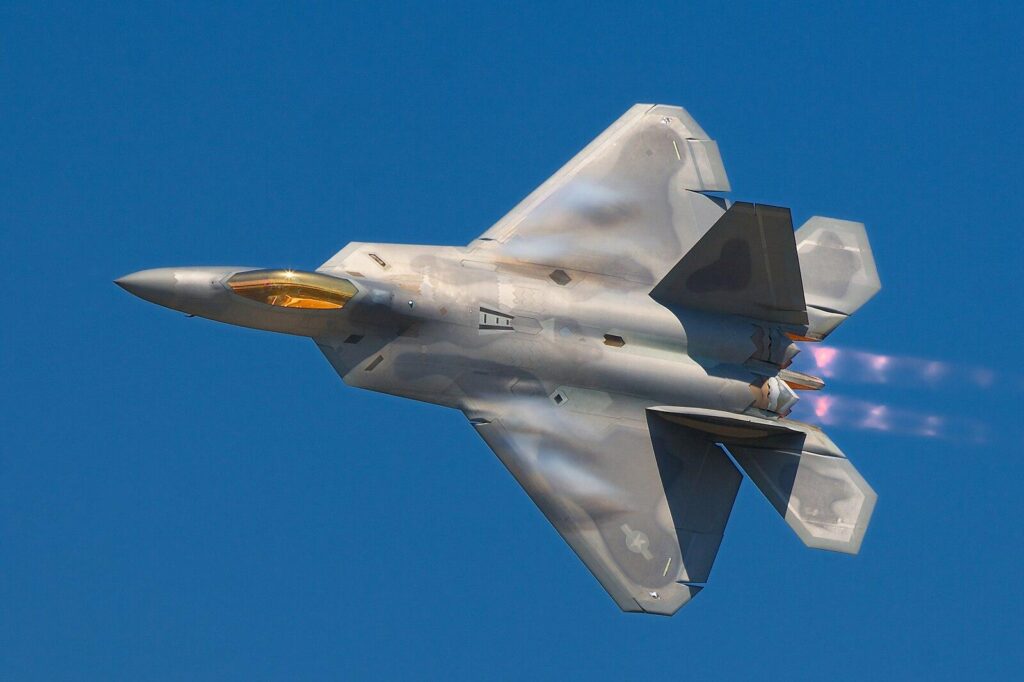
Aerial demonstrationF-22 maneuvering during an airshow.

Thrust-vectoring enginesThe twin-engine propulsion system.
For reusable official photographs, use the U.S. Air Force F-22 photo collection. Check the individual image’s credit and reuse conditions before publishing.
Video collection

F-22 Raptor Aerial Demonstration — Oshkosh 2025
1 minute 21 seconds • U.S. Air ForceWatch official video

F-22 Full Demonstration with Flares — Miami Beach
11 minutes 49 seconds • U.S. Air ForceWatch official video

F-22 Raptor Cockpit Footage
4 minutes • U.S. Air ForceWatch cockpit footage
WordPress publishing information
SEO title
Copy
F-22 Raptor: Stealth, Speed and Air SuperiorityURL slug
Copy
f-22-raptor-stealth-air-superiorityMeta description
Copy
Explore the F-22 Raptor’s history, stealth technology, Mach 2 performance, thrust-vectoring engines, weapons and air-superiority mission.Focus keywords
Copy
F-22 Raptor, F-22 fighter jet, stealth fighter, air superiority, Lockheed Martin F-22, fifth-generation fighter
Recommended category: Military Aircraft
Suggested tags: F-22, Raptor, Lockheed Martin, Stealth Aircraft, Military Aviation, Fighter Jets, Air Superiority
Featured image: F-22 Raptor in flight, preferably an official U.S. Air Force photograph.
Research sources
Official and specialist references for fact-checking and attribution:
- U.S. Air Force — F-22 technical fact sheet
- Lockheed Martin — F-22 development history
- National Museum of the U.S. Air Force
- Air & Space Forces Magazine — F-22 reference
This provides the article, SEO details, visual suggestions, and official video sources for planes.bin3aiah.net. The article has not been published to WordPress yet.