
Views: 0
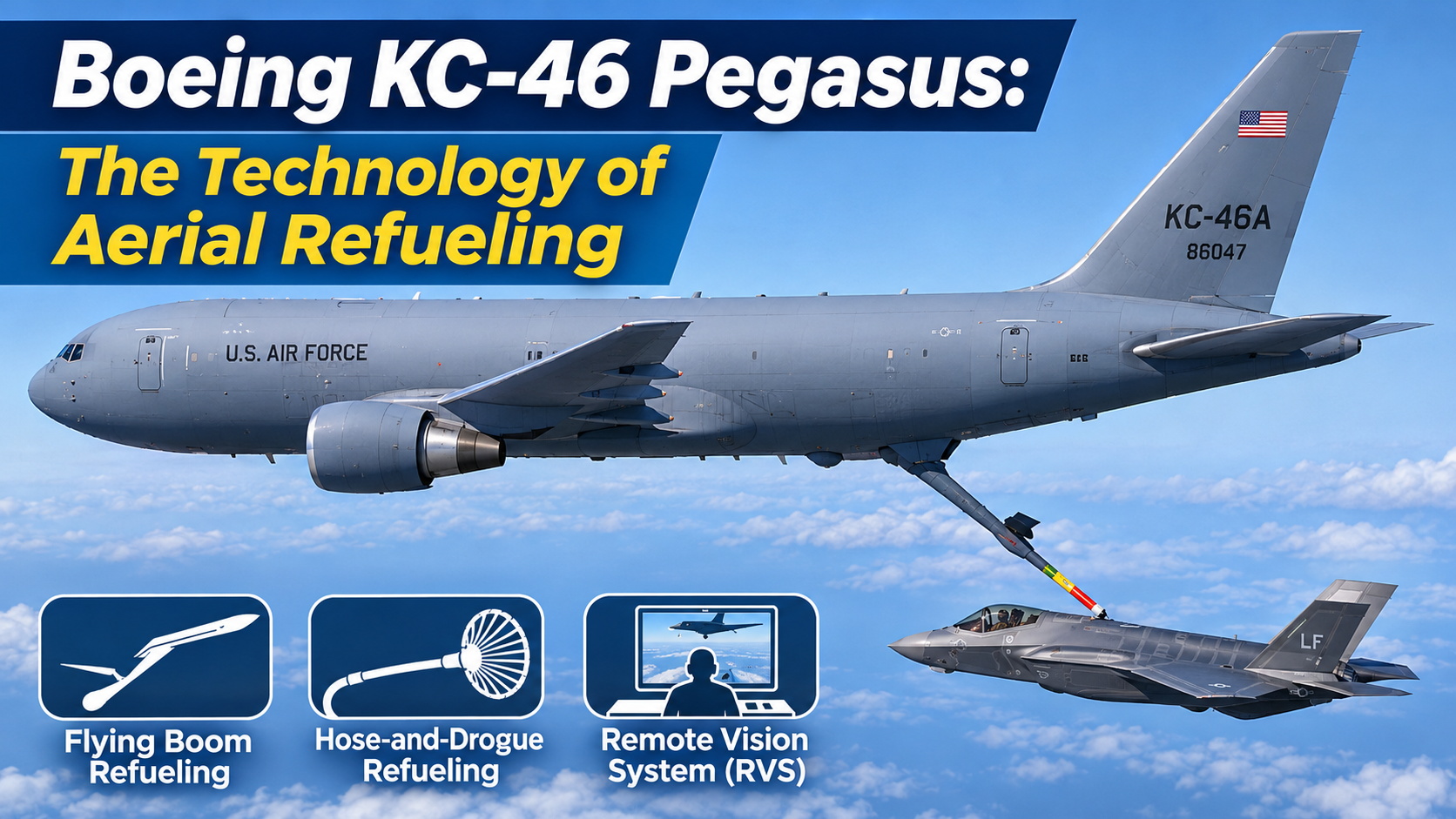
Boeing KC-46 Pegasus: The Technology of Aerial Refueling

The Boeing KC-46A Pegasus is one of the most technologically advanced aerial refueling aircraft developed for the United States Air Force. Built using a modified Boeing 767 airframe, the Pegasus combines high-capacity fuel delivery, digital refueling controls, advanced imaging systems, and military transport capabilities.
Aerial refueling allows military aircraft to remain airborne longer, travel farther, and operate without landing for fuel. This capability is essential for long-range missions, strategic air mobility, and supporting aircraft operating far from established airbases.
The KC-46A represents a significant evolution in tanker aircraft technology, particularly through its fly-by-wire refueling boom and camera-based remote vision system.
1. What Is the Boeing KC-46 Pegasus?
The KC-46A Pegasus is a military aerial tanker developed by Boeing to modernize the U.S. Air Force’s refueling fleet. It is designed to replace part of the aging KC-135 Stratotanker fleet while providing additional capabilities for cargo transport, passenger movement, and aeromedical evacuation.
The KC-46 program began in 2011, and the aircraft completed its initial flight in December 2014. The first KC-46A was delivered to the U.S. Air Force on January 25, 2019.
Unlike a conventional commercial airliner, the Pegasus carries specialized fuel transfer equipment, military communication systems, defensive features, and configurable cargo accommodations.
2. How Aerial Refueling Works
Aerial refueling involves transferring fuel from a tanker aircraft to another aircraft while both are flying in close formation. The receiving aircraft approaches the tanker at a controlled speed and position while trained crews coordinate the connection.
The KC-46A supports two primary methods of fuel transfer: the flying boom and the hose-and-drogue system.
Flying Boom Refueling

The flying boom is a rigid, telescoping tube extending from the rear underside of the tanker. The boom operator guides the equipment toward a refueling receptacle installed on the receiving aircraft.
Once connected, pumps transfer fuel from the tanker to the receiver. The boom system is particularly useful for aircraft that require large quantities of fuel, including heavy transport aircraft and strategic bombers.
The KC-46 uses a fly-by-wire boom control system. Electronic commands control boom positioning, allowing precise adjustments during refueling operations.
Hose-and-Drogue Refueling
The hose-and-drogue system uses a flexible refueling hose with a basket-shaped device called a drogue at its end.
A receiving aircraft equipped with a refueling probe approaches the basket and makes contact. Once the probe is properly engaged, fuel can transfer through the hose.
This method is commonly used by naval aircraft and other military aircraft designed around probe-based refueling.
The KC-46 can use a centerline drogue and optional wing-mounted refueling pods. When appropriately configured, it can refuel multiple compatible aircraft simultaneously through its hose-and-drogue systems.
3. The Remote Vision System
One of the most distinctive technologies aboard the KC-46 is its Remote Vision System, commonly called RVS.
Traditional aerial tankers such as the KC-135 use a boom operator positioned near the rear of the aircraft, where the operator directly observes the receiving aircraft through a window.
The KC-46 takes a different approach. Its boom operator sits at a workstation inside the aircraft, using exterior cameras and display screens to guide refueling operations.
Camera imagery provides information about the receiving aircraft’s position, the refueling boom, and the surrounding environment. The operator uses this imagery to control the connection while monitoring the operation.
However, the original RVS experienced technical deficiencies, particularly involving visual presentation and depth perception under some operating conditions.
Remote Vision System 2.0
Boeing and the U.S. Air Force have developed an upgraded system called RVS 2.0 to address limitations of the original equipment.
The upgraded system features improved cameras, enhanced processing hardware, and an immersive 4K Ultra HD three-dimensional display intended to provide more realistic visual information to boom operators.
On June 3, 2026, Boeing announced completion of the first phase of RVS 2.0 flight testing. The upgrade remained subject to additional certification, integration, and fielding work.
4. Boeing KC-46A Technical Specifications
| Specification | Details |
|---|---|
| Manufacturer | Boeing |
| Aircraft type | Aerial refueling tanker and military transport |
| Airframe | Modified Boeing 767 |
| Engines | 2 Pratt & Whitney PW4062 turbofans |
| Fuel capacity | 96,297 kg (212,299 lb) |
| Maximum takeoff weight | 188,240 kg (415,000 lb) |
| Wingspan | 47.5 m |
| Length | 48.5 m |
| Height | 15.5 m |
| Published maximum speed | Approximately 850 km/h |
| Published range | 6,385 nautical miles |
| Maximum cargo payload | 29,484 kg |
| Cargo pallet positions | 18 |
| Standard passenger capacity | 58 |
| First USAF delivery | January 25, 2019 |
Specifications are based on the U.S. Air Force Air Mobility Command fact sheet. Actual operational performance, fuel offload, and range vary according to mission configuration, payload, and flight conditions.
5. The Importance of Fuel Capacity
The KC-46 can carry approximately 96 metric tonnes of fuel. However, its total fuel capacity should not be confused with the amount available for transfer during every mission.
The tanker must retain sufficient fuel to complete its own flight, including the return journey and required reserves.
Actual fuel offload depends on the distance to the refueling area, altitude, weather, planned mission duration, and fuel requirements of the receiving aircraft.
6. Supporting Fighter Aircraft and Strategic Missions

Aerial refueling extends the reach of compatible fighter aircraft without requiring additional ground stops. This flexibility is especially valuable during long-distance deployments and operations where nearby airfields may be unavailable.
The KC-46 is intended to support a broad range of military receivers, including fighter aircraft, heavy transports, and bombers, subject to the relevant refueling clearances and operating procedures.
The aircraft’s ability to combine different refueling configurations also helps military planners support mixed aircraft formations.
7. Cargo and Aeromedical Evacuation Capabilities

Beyond aerial refueling, the KC-46 operates as a multimission transport aircraft.
Its main deck can be configured to carry palletized cargo, passengers, or aeromedical evacuation equipment. The aircraft accommodates up to 18 standard military cargo pallets, depending on the selected configuration.
These capabilities allow the Pegasus to transport personnel, move essential supplies, and support the evacuation of patients during military and humanitarian operations.
8. Safety and Technical Challenges
Aerial refueling is a demanding operation because two large, fast-moving aircraft must maintain carefully controlled relative positions.
Turbulence, aircraft movement, lighting, and changing aerodynamic forces can complicate the refueling process.
The KC-46 incorporates electronic boom controls, camera-based monitoring, and dedicated refueling procedures to help manage these challenges.
Nevertheless, the aircraft has experienced engineering and reliability issues, including difficulties involving its original Remote Vision System and refueling boom.
The development of RVS 2.0 is an important part of the continuing effort to improve the aircraft’s operational performance.
9. Why the KC-46 Matters to Modern Aviation
Aerial refueling is one of the technologies that makes modern long-range military aviation possible.
Without tanker aircraft, many military missions would require more intermediate stops, greater dependence on forward airbases, or reduced operational flexibility.
The Boeing KC-46 Pegasus combines fuel delivery with digital controls, improved situational awareness technology, and a transport-capable airframe.
Its development illustrates how modern aerospace engineering increasingly relies on integrating mechanical systems, electronic controls, sensors, and sophisticated operator interfaces.
Conclusion
The Boeing KC-46A Pegasus represents an important step in the modernization of aerial refueling.
With its fly-by-wire boom, hose-and-drogue compatibility, remote vision technology, and multimission transport capabilities, the aircraft provides a flexible platform for military air mobility.
Although some technical challenges remain, the Pegasus demonstrates how advanced engineering continues to reshape one of military aviation’s most essential capabilities: transferring fuel between aircraft thousands of meters above the ground.
Sources and Image Credits
- U.S. Air Force Air Mobility Command – KC-46A Pegasus Fact Sheet
- Boeing – RVS 2.0 Initial Flight Testing, June 2026
- Wikimedia Commons – KC-46A Aircraft Photograph
- Wikimedia Commons – KC-46 Refueling an F-15
- Wikimedia Commons – KC-46 and F-35
- Wikimedia Commons – KC-46 Cargo Operations
Photographs are credited to their respective U.S. Air Force photographers and are identified as public-domain U.S. government works. Use of military imagery does not imply endorsement.