
Views: 0
BIN3AIAH PLANES | AVIATION TECHNOLOGY | FLIGHT SYSTEMS
How Fly-by-Wire Flight Controls Work in Modern Airliners


8
Imagine flying a 300-tonne commercial aircraft with a small joystick. Instead of directly moving cables connected to the wings and tail, your movements are converted into electronic signals, interpreted by powerful computers, and translated into precisely controlled aircraft movements.
This is fly-by-wire (FBW), one of the most important innovations in modern aviation. It has transformed how airliners are flown, making flight-control systems more adaptable, efficient, and capable of helping pilots avoid dangerous flight conditions.
Fly-by-wire is used on aircraft including the Airbus A320, Airbus A350, Boeing 777, and Boeing 787 Dreamliner.
Airbus
+1
1. What exactly is fly-by-wire?
Traditional flight controls use mechanical connections such as cables, rods, and pulleys to transmit pilot inputs to control surfaces. Hydraulic systems often provide the force needed to move those surfaces.
Fly-by-wire replaces the primary mechanical command path with electronic signals. Computers interpret what the pilot wants the airplane to do and calculate the appropriate control-surface movements.
Simplified fly-by-wire control sequence
Pilot input
Sidestick, yoke or pedals
Flight-control computers
Process requests, sensor data and control laws
Actuators
Convert electrical commands into mechanical force
Flight-control surfaces move
Elevators, ailerons, rudder and spoilers
Sensors provide continuous feedback to the computers
Crucially, fly-by-wire does not mean all control surfaces are powered directly by electricity. Many modern airliners still use hydraulic actuators, with electrical signals providing the commands.
ATSB
+1
2. What happens when the pilot moves the controls?
Consider a pilot gently moving the sidestick to the right.
- Input detection: Sensors detect the direction and amount of sidestick movement.
- Electronic transmission: The input reaches the flight-control computers.
- Flight-state analysis: Computers examine information such as airspeed, attitude, acceleration, and available sensor data.
- Command calculation: The control laws determine how much the relevant surfaces should move.
- Physical movement: Actuators move the ailerons and other applicable surfaces, causing the airplane to roll.
- Feedback: Sensors monitor the aircraft’s actual response, enabling the computers to refine their commands.
The pilot does not necessarily request a specific number of degrees of aileron movement. Under many modern control laws, the pilot requests a desired aircraft response, and the computers determine how to produce it.
Introduction to Aerospace Flight Vehicles
+1
3. The main flight-control surfaces

Ailerons — Roll
Located toward the outer trailing edges of the wings. Their movements help bank the aircraft left or right.

Elevators — Pitch
Located on the horizontal tail. They control nose-up and nose-down motion.

Rudder — Yaw
Located on the vertical tail. It helps control left-right nose movement and maintain coordinated flight.

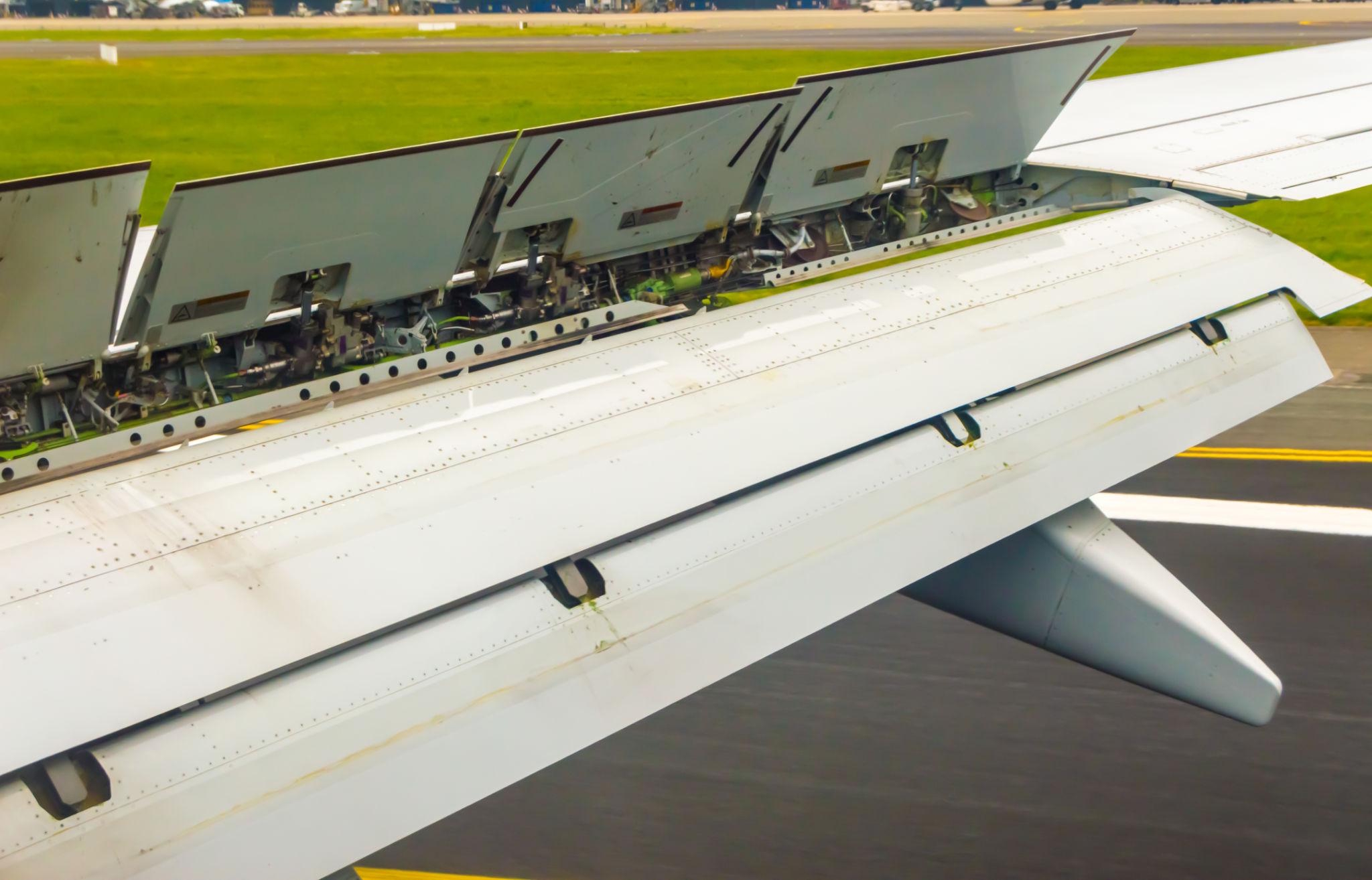
Spoilers — Lift reduction and roll assistance
Panels on top of the wings that reduce lift, assist some rolling maneuvers, and help slow the aircraft.
4. Flight-envelope protection: a digital safety layer
One of the biggest benefits of fly-by-wire is the ability to integrate flight-envelope protection.
An airplane’s flight envelope defines the operating boundaries associated with airspeed, aerodynamic loading, angle of attack, and flight attitude.
On aircraft with appropriate protections, computers can modify pilot commands to reduce the risk of exceeding these boundaries.
Examples on Airbus aircraft in normal law include:
- High angle-of-attack protection: Helps prevent the aircraft from exceeding a defined maximum aerodynamic angle of attack.
- Overspeed protection: Helps reduce the risk of excessive airspeed.
- Load-factor limitation: Limits commanded aerodynamic loads that could overstress the airframe.
- Pitch-attitude protection: Limits extreme nose-up and nose-down attitudes.
- Bank-angle protection: Helps prevent excessive banking.
These functions are dependent on aircraft type, system health, and the active flight-control mode. They cannot eliminate every dangerous situation.
Airbus
+1
5. Airbus vs Boeing: different design philosophies

Airbus sidestick

Boeing control yoke
Although both manufacturers use fly-by-wire technology, their implementations differ.
| Feature | Airbus A320 family | Boeing 777 |
|---|---|---|
| Pilot interface | Sidestick | Traditional yoke |
| Primary control | Electronic | Electronic |
| Flight envelope | Hard protections in normal law | Generally soft protections |
| Pilot feedback | Sidestick force and aircraft displays | Artificial control feel and yoke movement |
| Design emphasis | Computer-enforced operating boundaries | Traditional control feel and pilot authority |
The Boeing 777 generally uses protections that warn or resist excessive inputs while permitting pilot override, whereas the Airbus A320’s normal law actively limits certain commanded maneuvers. Both designs prioritize safe aircraft control, but use different approaches.
forum.helitavia.com
+1
6. What happens if the computers fail?
Fly-by-wire systems are designed with multiple layers of redundancy because flight control is safety-critical.
Depending on aircraft type, they include multiple independent computers, sensors, electrical power sources, and actuator control paths. If one part fails, another may continue operating.
For example, Airbus flight-control modes include:
Normal law
Full normal-law flight-control functions and available protections.
Alternate law
A degraded mode following certain failures. Some protections may be reduced or lost.
Direct law
A more direct relationship between cockpit inputs and control-surface commands, without normal flight-envelope protection.
These are broad descriptions. The precise failure logic and backup modes vary between aircraft families. The existence of redundancy does not make the system immune to every failure, including problems caused by incorrect sensor information.
ATSB
+1
7. Why fly-by-wire changed aviation
The technology has several major advantages:
- Reduced mechanical complexity: Fewer long mechanical linkages can lower aircraft weight and maintenance requirements.
- More consistent handling: Computers adapt the aircraft’s response to different flight conditions.
- Improved stability: Automatic corrections can help reduce unwanted motion.
- Safety functions: Flight-envelope protections can reduce risks from excessive pilot commands.
- Design flexibility: Engineers have greater freedom in configuring control systems and aircraft handling characteristics.
Its development owes much to early research conducted by NASA, particularly experimental digital fly-by-wire work on the F-8 aircraft during the 1970s. The Airbus A320 subsequently brought digital fly-by-wire into widespread commercial passenger service in 1988.
NASA
+1
8. Fly-by-wire vs autopilot
A common misunderstanding is that fly-by-wire and autopilot are the same thing.
They are not.
Fly-by-wire is the flight-control architecture that converts commands into aircraft movement. Autopilot is a system that generates control commands automatically to follow selected flight guidance.
A pilot can manually fly a fly-by-wire aircraft with the autopilot disengaged. When autopilot is engaged, the flight-control architecture can carry out its commands.
9. Watch: how fly-by-wire works

Captain Joe · Pilot explanation
A practical overview of computer-controlled flight surfaces and Airbus architecture.

A320 Flight Controls – FBW Overview
MindSpaceX Aviation · System walkthrough
Explains the electronic-to-hydraulic command chain, flight computers, and feedback.
NASA · Historical background
An official account of the research that helped make digital flight controls possible.
10. Conclusion
Fly-by-wire represents a fundamental change in aircraft design. It replaces long mechanical command linkages with electronic communication, sophisticated flight-control computers, and precise actuator commands.
It does not remove the pilot from the equation. Instead, it provides a powerful interface between the pilot and the aircraft, helping translate human intentions into controlled, predictable flight.
As aviation technology advances, fly-by-wire will remain one of the foundations of modern commercial aviation.
Publication package — Bin3aiah Planes
SEO details
Ready for editorial review
SEO title Copy
How Fly-by-Wire Flight Controls Work in Modern Airliners
URL slug Copy
how-fly-by-wire-flight-controls-work
Meta description Copy
Discover how fly-by-wire flight controls work in modern airliners, from cockpit inputs and flight computers to Airbus and Boeing safety systems.
Category Copy
Aircraft Technology
Tags Copy
Fly-by-Wire, Airbus, Boeing, Flight Controls, Aviation Engineering, Aircraft Safety
Recommended featured image: An Airbus A350 cockpit photograph highlighting the sidestick and digital flight deck, ideally accompanied by an appropriately licensed flight-control schematic.
Suggested image alt text: Airbus A350 fly-by-wire cockpit showing digital flight displays and sidestick controls.
Primary technical references: Airbus – Fly-by-Wire, Airbus – Flight Envelope Protection, and NASA – Digital Fly-by-Wire.
The article content and SEO details are prepared for planes.bin3aiah.net. The imagery above serves as visual references; publication requires checking image reuse rights and attribution. The post has not been uploaded or published to WordPress.