
Views: 0
NASA X-59: Researching Quieter Supersonic Flight
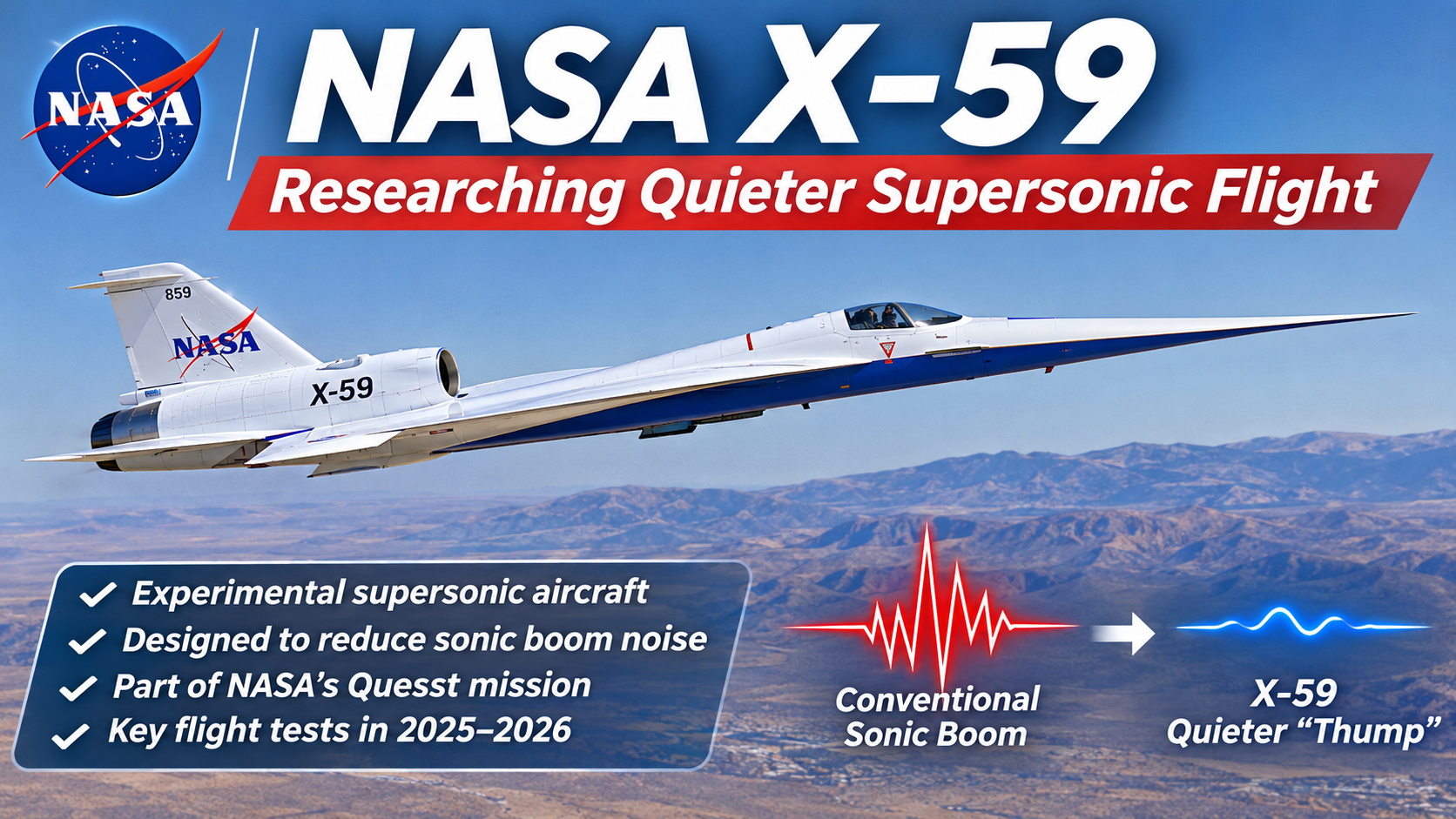
NASA’s X-59 is one of the most innovative experimental aircraft developed in recent aviation history. Designed to fly faster than the speed of sound while producing a much quieter sonic signature, it could help transform the future of high-speed air travel.
Built by Lockheed Martin Skunk Works for NASA, the X-59 is the centerpiece of the Quesst mission. Its purpose is not to transport passengers but to demonstrate technology that could eventually allow quieter commercial supersonic flights over populated land areas.

What Is the NASA X-59?
The X-59 is a single-seat experimental jet engineered to investigate low-boom supersonic flight. Unlike conventional supersonic aircraft, which generate powerful sonic booms, the X-59 uses a carefully shaped fuselage and other aerodynamic features to reduce the noise reaching people on the ground.
NASA aims to measure the sounds produced by the aircraft and collect public responses during future community overflights. The findings could provide regulators with scientific evidence for reconsidering restrictions on commercial supersonic flight over land.
NASA X-59 Specifications
| Specification | Details |
|---|---|
| Manufacturer | Lockheed Martin Skunk Works |
| Operator | NASA |
| Mission | Quesst |
| Aircraft Type | Experimental supersonic research aircraft |
| Length | Approximately 30.4 meters |
| Research Cruise Speed | Mach 1.4 |
| Research Cruise Altitude | Approximately 55,000 feet |
| Crew | One pilot |
| First Flight | October 28, 2025 |
| First Supersonic Flight | June 5, 2026 |
How Does the X-59 Reduce Sonic Booms?
When an aircraft exceeds the speed of sound, it creates shock waves that travel through the atmosphere. Conventional aircraft can cause these pressure waves to combine into powerful sonic booms, which may be heard over large areas.
The X-59 is engineered to control how these pressure waves form and interact. Instead of allowing them to merge into strong shocks, the aircraft’s shape is designed to distribute the pressure changes and produce a gentler sound on the ground.
1. A Long, Slender Nose
One of the X-59’s most recognizable features is its unusually elongated nose. The narrow shape helps manage shock-wave formation along the aircraft, reducing the intensity of the pressure changes that eventually reach the ground.
2. Carefully Designed Aerodynamics
The fuselage, wings, and other surfaces work together to control airflow at supersonic speeds. Their shapes and positions are central to the aircraft’s low-boom design.
3. Engine Placement Above the Fuselage
The jet engine is positioned on top of the aircraft rather than underneath it. This arrangement helps shield the ground from some of the shock waves associated with the engine installation.
4. The External Vision System
The aircraft’s extremely long nose makes a conventional forward-facing cockpit window impractical. Instead, its External Vision System uses cameras and a high-resolution display to provide the pilot with a view ahead of the aircraft.

The X-59’s First Flight
On October 28, 2025, the X-59 successfully completed its maiden flight from Palmdale, California, to NASA’s Armstrong Flight Research Center at Edwards.
NASA test pilot Nils Larson operated the aircraft during the 67-minute flight. The X-59 reached approximately 12,000 feet and a top speed near 230 mph, with its landing gear remaining extended.
The first flight was deliberately conservative. Engineers focused on evaluating basic aircraft handling, flight-control responses, and system performance before gradually expanding the flight envelope.

Breaking the Sound Barrier in 2026
The X-59 achieved another major milestone on June 5, 2026, when it successfully exceeded the speed of sound for the first time.
During the flight, NASA test pilot Jim “Clue” Less reached approximately Mach 1.1 and an altitude of 43,400 feet. The flight lasted 81 minutes and represented a critical step toward the aircraft’s intended research operating conditions.
Initial supersonic flights focused on aircraft performance rather than independently proving the low-boom sound signature. NASA’s chase aircraft produced conventional sonic booms that could interfere with acoustic observations.
NASA X-59 Flight-Test Progress
By October 28, 2026, NASA reported that the X-59 had completed 40 additional flights since its first flight, reaching speeds of up to Mach 1.53 and altitudes exceeding 56,000 feet.
These accomplishments demonstrated progress in validating the aircraft across its flight envelope. The Quesst team was preparing to place greater emphasis on acoustic measurements and confirming how its shock waves behave under real atmospheric conditions.

What Is NASA’s Quesst Mission?
Quesst is NASA’s research program for investigating how quieter supersonic flight could change aviation regulations and aircraft design.
The mission has three main stages:
- Aircraft development and flight testing: Build the X-59 and establish its operational and safety performance.
- Acoustic validation: Measure shock waves and verify the aircraft’s low-boom performance in flight.
- Community response testing: Fly over selected communities and survey residents about the sounds they experience.
The final research data will be shared with national and international aviation regulators to help inform possible future noise standards for supersonic commercial flight over land.
Why Is Quiet Supersonic Flight Important?
Commercial supersonic aviation has long faced operational restrictions because conventional sonic booms can disturb people and communities beneath flight paths.
The X-59 could help change how regulators assess supersonic flight by providing measurements of actual noise exposure and public responses, rather than relying solely on aircraft speed.
If future passenger aircraft successfully use similar low-boom technology, faster routes across continents could become possible. However, quieter sonic booms alone would not solve every challenge associated with commercial supersonic transportation.
Challenges Facing Future Supersonic Aircraft
Even if the Quesst mission achieves its acoustic objectives, aircraft manufacturers must still address several practical challenges:
- Fuel efficiency and operating economics at supersonic speeds.
- Aircraft emissions and environmental performance.
- Noise during takeoff and landing.
- Passenger comfort, safety, and certification requirements.
- Regulatory approval for commercial supersonic routes.
The X-59 is not a prototype passenger airliner. It is a specialized research aircraft intended to generate scientific knowledge that future commercial designs may use.
Conclusion: The Future of Quieter Supersonic Aviation
NASA’s X-59 represents a major shift in supersonic aircraft research. Instead of concentrating only on achieving greater speed, the program aims to make faster-than-sound flight less disruptive to communities below.
From its distinctive long nose and innovative pilot-vision technology to its successful supersonic testing in 2026, the X-59 demonstrates how aerodynamic engineering can address a longstanding aviation problem.
The ultimate success of the Quesst mission will depend on acoustic measurements and community feedback. Its results may help shape the next generation of commercial supersonic aircraft and future aviation noise regulations.
Official References and Further Reading
- NASA Quesst Mission
- NASA X-59 Aircraft Specifications
- NASA X-59 First Supersonic Flight — June 2026
- NASA X-59 One-Year Flight-Test Progress — October 2026
- NASA Quesst Official Image Gallery
Article updated: November 2026. Aircraft photographs are credited to NASA and their respective photographers. Images are linked from Wikimedia Commons; consult the individual file pages and NASA media usage guidelines before republication.