
Views: 2
BIN3AIAH PLANES | AVIATION ENGINEERING
Airbus A330neo: How Modern Engines Improve Long-Haul Efficiency
Next-generation turbofan technology, advanced aerodynamics and smarter long-haul operations.

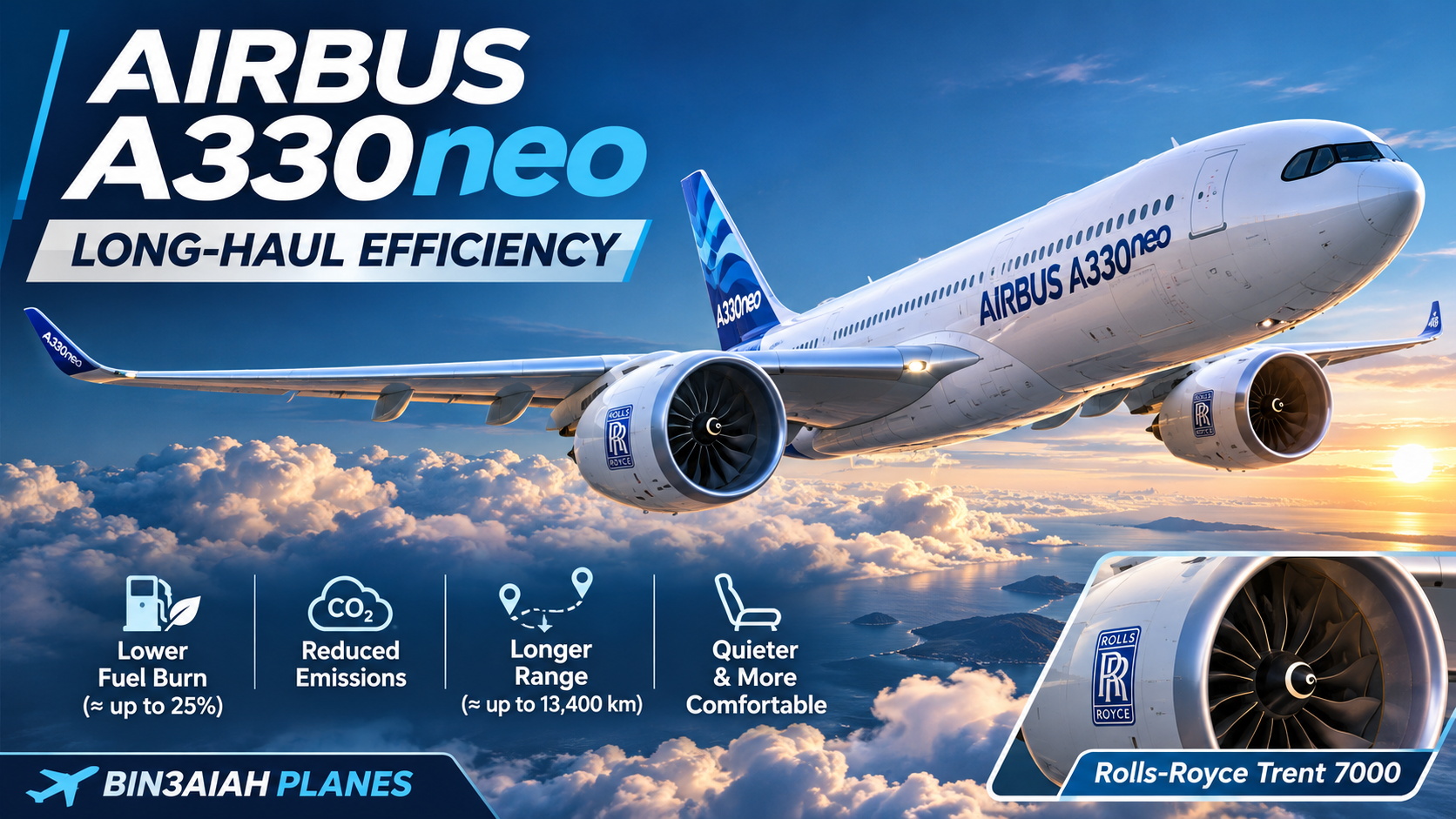
The Airbus A330neo represents an important evolution in modern commercial aviation. Instead of developing an entirely new widebody aircraft, Airbus modernized its established A330 platform with advanced engines, improved wings and updated cabin technology.
At the heart of this transformation is the Rolls-Royce Trent 7000, a high-bypass turbofan designed to reduce fuel consumption while supporting efficient medium-haul and long-haul operations.
Lower fuel burn per seat versus earlier A330 generations
Engine bypass ratio
Wingspan
Maiden flight
1. What Is the Airbus A330neo?
The term NEO stands for New Engine Option. Airbus launched the A330neo programme in July 2014 to improve the economics and environmental performance of its popular twin-engine widebody family.
The first A330neo flew on 19 October 2017, followed by commercial entry into service in 2018 with TAP Air Portugal.
The family consists of two aircraft:
- A330-800: A shorter-fuselage variant optimized for lower-capacity, longer-distance routes.
- A330-900: A larger variant designed to carry more passengers and improve seat-mile economics.
2. Airbus A330neo Technical Specifications
| Specification | A330-800 | A330-900 |
|---|---|---|
| Aircraft type | Widebody twinjet | Widebody twinjet |
| Length | 58.82 m | 63.66 m |
| Wingspan | 64 m | 64 m |
| Engines | 2 × Trent 7000 | 2 × Trent 7000 |
| Cruise speed | Mach 0.82 | Mach 0.82 |
| Approximate range | 8,100 nmi | 7,350 nmi |
| Typical seating | 220–260 | 260–300 |
| First flight | 2018 | 2017 |
Range and seating figures are indicative. Actual performance depends on aircraft configuration, weight, payload and operating conditions.
3. Rolls-Royce Trent 7000: The Heart of the A330neo

The Trent 7000 is the exclusive engine for both A330neo variants. It incorporates technologies developed through the Rolls-Royce Trent engine family, including advances associated with the Trent 1000 and Trent XWB.
Key Engine Technologies
- Large 112-inch fan diameter.
- Approximately 10:1 bypass ratio.
- Three-shaft turbofan architecture.
- Lightweight hollow titanium fan blades.
- Advanced compressor and turbine aerodynamics.
- Modern acoustic treatments.
- Electronically controlled engine management.
4. How a High-Bypass Turbofan Saves Fuel
A turbofan produces thrust by accelerating air backward. Some air passes through the engine core, while the remaining air flows around the core through the bypass duct.
The Trent 7000’s large fan moves a substantial mass of air at a comparatively lower velocity. This improves propulsive efficiency at the speeds normally used by commercial aircraft.
Understanding the 10:1 Bypass Ratio
For approximately every one unit of air passing through the engine core, ten units flow through the bypass duct.
Illustrative airflow comparison, not a physical engine cross-section.
Accelerating a larger quantity of air by a smaller amount generally wastes less kinetic energy than accelerating a smaller quantity of air to much higher speeds. This principle helps reduce the fuel required to generate thrust.
5. Advanced Engine Core Technology
Propulsive efficiency is only one part of the equation. The Trent 7000 also incorporates improvements in thermal efficiency, which determines how effectively energy from burning fuel is converted into useful work.
Modern compressor designs, turbine cooling systems, advanced materials and aerodynamic refinements help the engine extract more useful energy from its fuel.
The three-shaft architecture allows different groups of compressor and turbine stages to operate at speeds suited to their individual functions.
6. Improved Wing Aerodynamics
Airbus redesigned important aerodynamic elements of the A330neo rather than simply installing new engines on the original aircraft.
Simplified engineering illustration — not to scale.
The aircraft features a 64-metre wingspan, redesigned wingtip devices and optimized aerodynamic surfaces. Its curved Sharklets help reduce induced drag associated with wingtip vortices.
- Reduced aerodynamic drag.
- Improved lift-to-drag ratio.
- Lower thrust requirements during cruise.
- Improved fuel efficiency over long distances.
Engine nacelles and pylons were also refined to integrate the larger Trent 7000 engines while limiting additional aerodynamic penalties.
7. A330neo Fuel Efficiency Explained
Rolls-Royce reports approximately 14% better fuel consumption per seat for the A330neo and Trent 7000 combination compared with the previous Trent 700-powered A330 generation.
Airbus also promotes a reduction of approximately 25% per seat when comparing the A330neo against selected older-generation competing widebody aircraft.
Illustrative Fuel Consumption Index
Previous A330 generation — 100
A330neo — 86
Indexed comparison based on the manufacturer’s reported 14% per-seat improvement. Not an actual flight fuel-burn measurement.
These figures describe different comparison baselines and should not be added together. Actual airline fuel consumption depends on seating density, payload, weather, flight distance and operating procedures.
8. Lower Noise and Environmental Impact
The large fan, advanced blade design and acoustic treatments help reduce engine noise. Improved fuel efficiency also reduces carbon dioxide emissions for comparable transport work when conventional jet fuel is used.
However, the A330neo remains a fuel-burning aircraft. Its environmental benefits represent improvements in efficiency rather than the elimination of aviation emissions.
9. Long-Haul Airline Economics
Fuel is a major airline operating expense. Even a modest improvement in fuel efficiency can become financially significant when an aircraft operates thousands of flight hours annually.
The A330neo offers several potential economic advantages:
- Reduced fuel expenditure per passenger seat.
- Greater flexibility across medium and long-haul routes.
- Commonality with existing Airbus A330 fleets.
- Potentially lower fleet-transition costs.
- Passenger and cargo revenue opportunities.
- Improved competitiveness on routes with moderate passenger demand.
10. Airspace Cabin and Passenger Comfort
Airbus introduced its Airspace cabin concept on the A330neo, incorporating redesigned interior elements intended to improve the passenger experience.
- Modern LED ambient lighting.
- Updated overhead storage options.
- Improved cabin aesthetics.
- Modern entertainment and connectivity options.
- Typical eight-abreast economy seating, depending on the airline.
Cabin layouts, seat dimensions and onboard facilities vary between operators.
11. Airbus A330neo Photo Gallery
Explore additional aircraft, engine, wing and cabin photography from Wikimedia Commons.


- A330-900 aircraft gallery
- A330neo family gallery
- Trent 7000 engine gallery
- Passenger cabin gallery
- Aircraft in flight
12. Airbus A330neo Videos
- Airbus A330neo maiden flight
- Rolls-Royce Trent 7000 engine technology
- Airbus A330neo Airspace cabin experience
13. Frequently Asked Questions
What does A330neo stand for?
NEO means New Engine Option.
Which engines power the Airbus A330neo?
Both variants exclusively use two Rolls-Royce Trent 7000 turbofan engines.
Is the A330neo more efficient than the original A330?
Yes. Its modern engines and aerodynamic improvements deliver approximately 14% better fuel consumption per seat compared with the previous Trent 700-powered generation, according to Rolls-Royce.
Which A330neo variant has the longer range?
The shorter A330-800 generally offers a longer published maximum range than the A330-900.
Why does a larger engine fan improve efficiency?
A larger fan can generate thrust by accelerating more air at a lower velocity, improving propulsive efficiency at typical commercial cruise speeds.
Conclusion
The Airbus A330neo demonstrates how modern engineering can extend the competitiveness of an established aircraft platform. Its Rolls-Royce Trent 7000 engines, aerodynamic improvements and updated cabin combine to create a versatile widebody aircraft suited to contemporary airline operations.
By reducing the fuel required per passenger seat, the A330neo illustrates the importance of engine efficiency and aerodynamic integration in the future of long-haul aviation.