
Views: 0
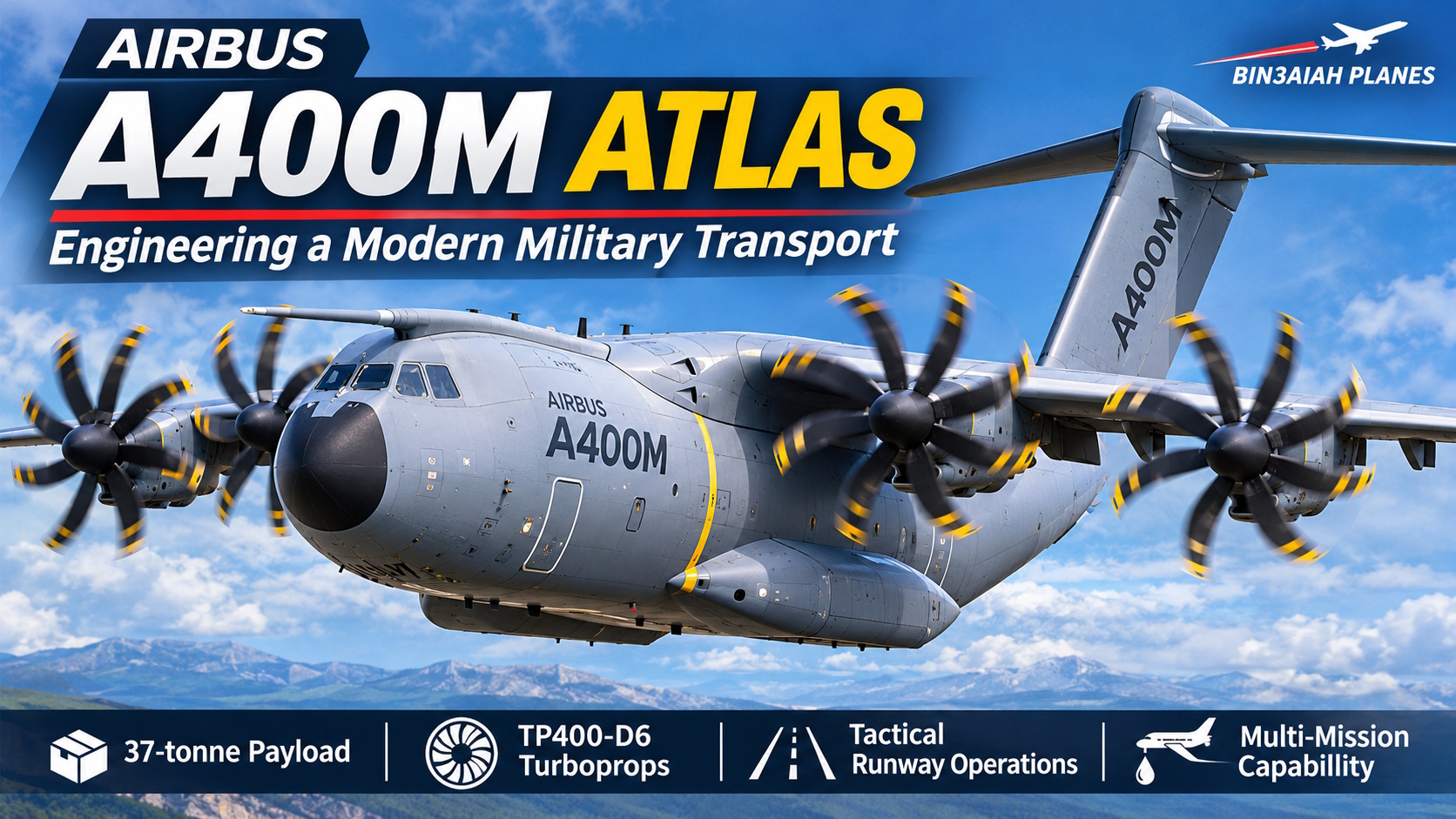
Airbus A400M Atlas: Engineering a Modern Military Transport
The Airbus A400M Atlas is one of the most advanced military transport aircraft developed in Europe. Built by Airbus Defence and Space, this four-engine turboprop airlifter combines the range of a strategic transport with the rugged performance needed for tactical missions.
Designed to carry troops, military vehicles, helicopters, humanitarian supplies and heavy cargo, the A400M fills an important operational gap between smaller tactical transports and larger strategic airlifters.

1. Airbus A400M Atlas: Technical Specifications
| Specification | Details |
|---|---|
| Manufacturer | Airbus Defence and Space |
| First flight | 11 December 2009 |
| Service introduction | 2013 |
| Length | 45.1 metres |
| Wingspan | 42.4 metres |
| Height | 14.7 metres |
| Engines | 4 × Europrop TP400-D6 turboprops |
| Engine power | Approx. 11,000 shp each |
| Maximum payload | 37,000 kg |
| Maximum takeoff weight | 141,000 kg |
| Cruise speed | Mach 0.68–0.72 |
| Range with 30-tonne load | Approx. 4,450 km |
| Cargo volume | Approx. 340 m³ |
| Primary roles | Military airlift, airdrop, aerial refuelling, humanitarian relief and medical evacuation |
2. Engineering the TP400-D6 Engines
The A400M is powered by four Europrop TP400-D6 turboprop engines, each producing approximately 11,000 shaft horsepower.
Each engine drives an eight-bladed composite propeller. These powerful engines deliver the combination of thrust, cruise efficiency and low-speed performance required for tactical airlift.

Why use turboprop engines?
Unlike large jet-powered transport aircraft, the A400M uses powerful turboprops to achieve several engineering advantages:
- Strong low-speed thrust: supports takeoffs and landings at challenging airfields.
- Fuel efficiency: provides economical cruise performance across demanding transport missions.
- Reverse thrust: helps reduce landing rollout.
- Operational flexibility: supports missions involving short and semi-prepared runways.
The A400M also features a distinctive counter-rotating propeller arrangement on each wing, known as the Down Between Engines configuration. This arrangement improves airflow around the wing and contributes to aerodynamic efficiency.
3. Advanced Aerodynamic Design
The A400M features a high-mounted swept wing, a T-tail and an aerodynamic configuration designed to combine efficient cruising with low-speed handling.

Its aerodynamic design delivers four major benefits:
- High-mounted wings: provide additional ground clearance for the engines and propellers.
- Advanced high-lift devices: improve performance during takeoff and landing.
- T-tail arrangement: accommodates the large rear cargo loading area.
- Modern flight controls: support precise handling across a wide operating envelope.
Engineers optimized the aircraft not simply for speed, but for a practical balance between payload, range, runway performance and operational versatility.
4. Cargo Bay and Heavy Equipment Transport
The A400M was specifically engineered to transport equipment that can be too large or heavy for smaller tactical airlifters.
Its large cargo hold, reinforced structure and rear loading ramp make it suitable for transporting military vehicles, cargo pallets, relief supplies and a variety of specialized equipment.

Key cargo capabilities
- Maximum payload of 37 tonnes.
- Approximately 340 cubic metres of cargo volume.
- Transport of selected military vehicles and helicopters within loading limits.
- Accommodation of military pallets and personnel configurations.
- Rear cargo ramp for rapid loading and unloading.
- Equipment and personnel airdrop capabilities.
The cargo compartment can be configured for different missions, including logistics, troop transport and medical evacuation.
5. Operating from Short and Unpaved Runways
One of the A400M’s defining advantages is its ability to operate from suitable short and semi-prepared runways.
Many larger transport aircraft rely heavily on established airport infrastructure. The A400M was designed to extend airlift operations into more challenging environments.
Its robust landing gear, powerful propulsion system and advanced wing design help support operations from selected grass, sand and other semi-prepared surfaces.
Airbus has described mission scenarios involving the delivery of a 25-tonne payload to an approximately 750-metre semi-prepared airstrip under specified conditions.
Actual runway requirements depend on payload, fuel, elevation, weather, ground strength and aircraft performance limitations.
6. Military Missions and Operational Flexibility
The A400M is designed for more than conventional cargo transport. It can perform a variety of military and humanitarian missions.
Strategic Airlift
The aircraft can carry substantial payloads over long distances, helping transport equipment and supplies between major operating bases.
Tactical Airlift
Its runway performance and cargo systems allow it to deliver military supplies closer to forward operating areas where suitable airstrips are available.
Airdrop Operations
The aircraft supports aerial delivery of cargo and paratroopers using mission-specific procedures and equipment.
Aerial Refuelling
When equipped with the appropriate tanker systems, the A400M can transfer fuel to compatible aircraft using hose-and-drogue equipment.
Humanitarian Relief
The aircraft can transport medical equipment, emergency food, water, shelters and other vital supplies after natural disasters.
Medical Evacuation
With the appropriate interior configuration, the A400M can support aeromedical evacuation missions involving patients and medical teams.
7. Advanced Cargo Handling and Logistics
Military airlift effectiveness depends not only on how much an aircraft can carry, but also on how quickly and safely its cargo can be loaded, secured and unloaded.

The A400M uses an integrated cargo-handling system with floor equipment, restraint provisions and loading arrangements that support different cargo types.
This versatility is important in rapidly changing operations where the same aircraft may need to transport vehicles, equipment, supplies or personnel on successive flights.
8. Airbus A400M vs C-130J vs C-17
| Feature | C-130J | A400M | C-17 |
|---|---|---|---|
| Engines | 4 turboprops | 4 turboprops | 4 turbofans |
| Approx. maximum payload | 20 tonnes | 37 tonnes | 77.5 tonnes |
| Transport role | Tactical | Tactical / strategic | Strategic / tactical |
| Key strength | Smaller airfields | Balanced capability | Very heavy cargo |
Figures are approximate and vary by aircraft variant and operating conditions.
The A400M occupies the middle ground between the smaller C-130J and the much larger C-17, providing greater payload capacity than the former while retaining specialized tactical transport capabilities.
9. Engineering Challenges and Limitations
The development of the A400M involved major engineering challenges. Integrating powerful turboprop engines, advanced flight controls, complex gearboxes and tactical transport requirements contributed to programme delays and cost increases.
Like other specialized military aircraft, the A400M also has important limitations:
- Its maximum payload is substantially lower than that of the larger C-17.
- Its sophisticated propulsion and flight systems require specialized maintenance.
- Unpaved runway operations depend on strict surface and performance requirements.
- Mission-specific equipment and aircraft configurations affect available capabilities.
These limitations reflect the compromises involved in designing a single aircraft for both strategic and tactical missions.
10. The Future of the A400M Atlas
The A400M continues to evolve as operators develop and expand its mission capabilities.
Future development areas include improved operational efficiency, specialized mission equipment, aerial refuelling capabilities and potential additional applications such as firefighting.
Its versatility makes the aircraft an important platform for air forces requiring flexible logistics and transport capabilities.
Conclusion: A Major Achievement in Military Aerospace Engineering
The Airbus A400M Atlas demonstrates how advanced aerodynamics, powerful turboprop propulsion, modern flight-control technology and innovative cargo systems can be combined in a modern military aircraft.
With a maximum payload of 37 tonnes, strong tactical runway performance and multiple mission configurations, it bridges an important gap in military airlift capability.
The A400M is more than a cargo aircraft. It is a highly adaptable aerospace platform designed to support military operations, humanitarian assistance and critical transport missions.
References and Further Reading
- Airbus – Official A400M Aircraft Overview
- OCCAR – A400M Technical Fact Sheet
- MTU Aero Engines – TP400-D6
- German Air Force – A400M
Photo Credits
Airbus A400M in flight: Sunburn1979 / Wikimedia Commons, CC BY-SA 2.0.
TP400 engine: Alexandru.rosu / Wikimedia Commons, CC BY-SA 4.0.
RAF A400M underside: Mark Harkin / Wikimedia Commons, CC BY 2.0.
Cargo-operation photographs: U.S. Air Force / Defense Visual Information Distribution sources.
Published by Bin3aiah Planes
Exploring the world’s aircraft, aviation technology and aerospace engineering.