
Views: 9
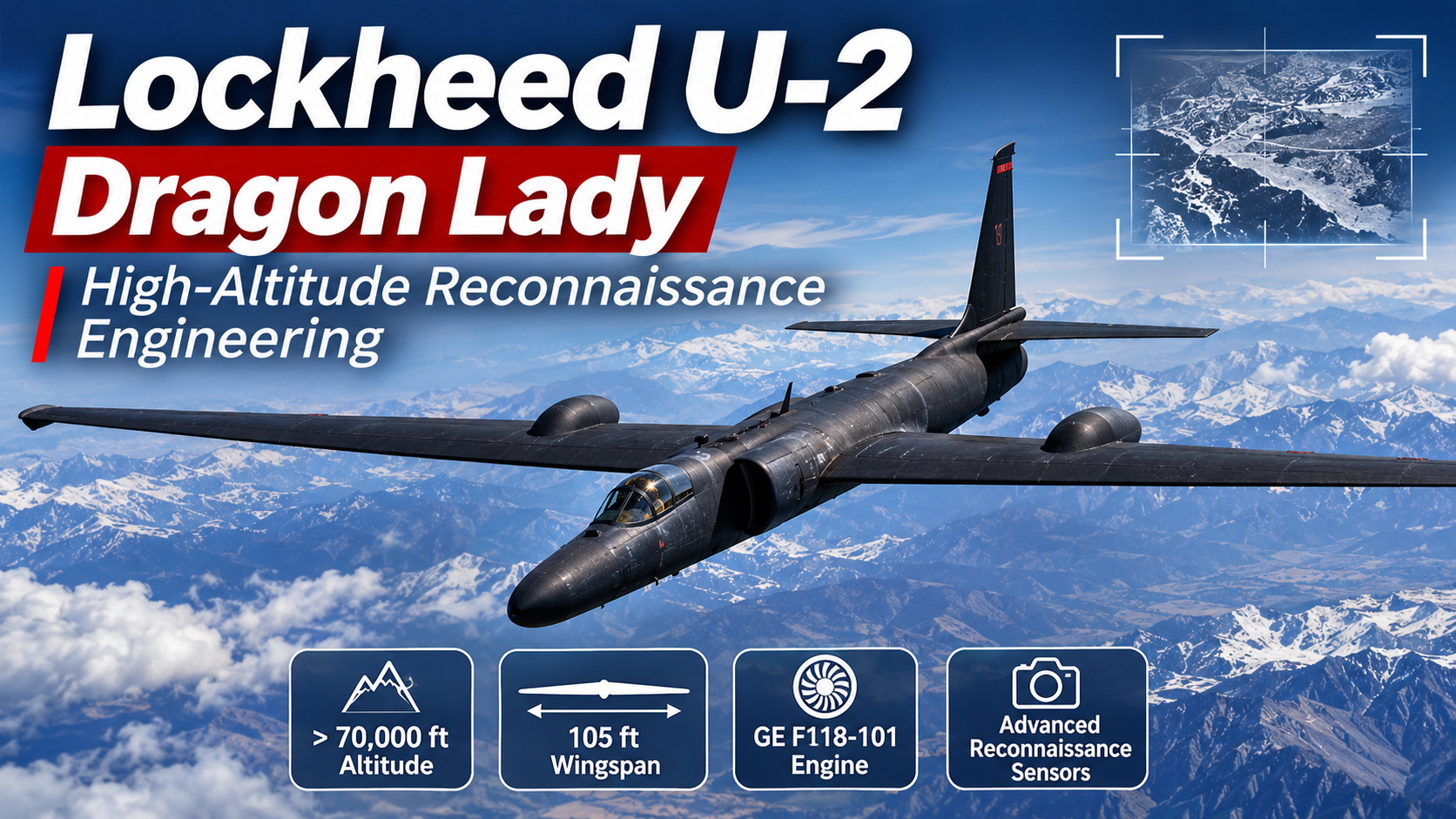
The Lockheed U-2 Dragon Lady is one of the most extraordinary reconnaissance aircraft ever engineered. Developed by Lockheed’s secretive Skunk Works division during the Cold War, this remarkable aircraft was designed to operate at altitudes above 70,000 feet while collecting valuable intelligence.
Its unusual appearance, enormous wingspan, specialized jet engine, and sophisticated surveillance systems make the U-2 a fascinating example of aerospace engineering.
First flown in 1955, the Dragon Lady has undergone decades of modernization, transforming from a relatively simple photographic reconnaissance aircraft into an advanced intelligence, surveillance, and reconnaissance platform.

Lockheed U-2S: Technical Specifications
| Manufacturer | Lockheed / Lockheed Martin |
| Aircraft Type | High-altitude reconnaissance |
| First Flight | August 1, 1955 |
| Crew | 1 pilot |
| Length | 63 ft (19.2 m) |
| Wingspan | 105 ft (32 m) |
| Engine | General Electric F118-101 turbofan |
| Thrust | Approximately 17,000 lbf |
| Operating Altitude | Above 70,000 ft (21,300 m) |
| Speed | Approximately 410 mph (660 km/h) |
| Range | More than 7,000 miles (11,300 km) |
| Mission | Intelligence, surveillance and reconnaissance |
Specifications are representative figures for the U-2S. Values vary between aircraft generations and mission configurations.
1. High-Altitude Aerodynamic Engineering
The U-2’s most recognizable characteristic is its extremely long and slender wing.
While conventional fighter aircraft emphasize speed, acceleration, and maneuverability, the Dragon Lady prioritizes aerodynamic efficiency at extreme altitudes.
At 70,000 feet, atmospheric density is only a small fraction of that found near sea level. Generating sufficient lift therefore becomes a major engineering challenge.
The U-2 addresses this challenge through a high-aspect-ratio wing that resembles the design of a sailplane.
Why Are the Wings So Long?
- Reduced induced drag: Long wings help minimize the drag associated with generating lift.
- Improved aerodynamic efficiency: The aircraft can sustain flight in thin air with relatively modest thrust.
- Extended endurance: Efficient aerodynamics support long-duration reconnaissance missions.
- High-altitude performance: The specialized wing helps the aircraft operate where conventional aircraft cannot.
2. Coffin Corner: An Extreme Flight Challenge
One of the most unusual characteristics of the U-2 is its narrow operating speed envelope at high altitude.
As altitude increases, the aircraft approaches a region where low-speed aerodynamic stall and high-speed compressibility limitations become increasingly close together.
This demanding condition is known as coffin corner.
Flying too slowly may produce an aerodynamic stall, while flying too fast can introduce dangerous compressibility effects and aerodynamic loads.
The resulting small margin requires precise control of speed, altitude, and aircraft configuration.

3. General Electric F118-101 Engine
The modern U-2S is powered by a General Electric F118-101 turbofan engine.
Earlier U-2 aircraft used Pratt & Whitney turbojet engines. The later turbofan upgrade improved reliability, efficiency, and mission capability.
Operating a jet engine above 70,000 feet presents significant challenges because the available oxygen and atmospheric pressure are greatly reduced.
Propulsion Engineering Advantages
- Efficient thrust generation for sustained high-altitude flight.
- Improved fuel efficiency for extended reconnaissance missions.
- Reduced maintenance demands compared with older engine configurations.
- Improved operating reliability and mission flexibility.
Unlike the supersonic SR-71 Blackbird, the U-2 relies on altitude, endurance, and intelligence-collection capability rather than extreme speed.
4. Reconnaissance Sensors and Intelligence Technology
Modern U-2 aircraft carry sophisticated reconnaissance equipment capable of collecting information across multiple intelligence disciplines.
The aircraft can support electro-optical imagery, radar surveillance, signals intelligence, and specialized electronic measurements.
High-Resolution Imaging
Advanced imaging systems allow the aircraft to observe large geographical areas from extreme altitude.
Synthetic Aperture Radar
Synthetic aperture radar uses aircraft movement and radar signal processing to produce detailed ground imagery.
Unlike conventional optical cameras, radar imaging can operate at night and through many atmospheric conditions that obscure visible-light photography.
Signals Intelligence
Specialized electronic payloads can collect and analyze selected electromagnetic emissions.
Advanced Data Communications
Modern communications equipment allows intelligence gathered during missions to be transmitted to supported ground stations and processing networks.
The U-2’s modular sensor architecture enables mission equipment to be upgraded without requiring a completely new aircraft design.
5. The Unusual Bicycle Landing Gear
One of the Dragon Lady’s most distinctive engineering features is its unconventional landing gear.
Rather than placing conventional main landing wheels beneath each wing, the U-2 uses a bicycle-style arrangement along the aircraft’s centerline.
Temporary auxiliary wheels called pogos support the wings during ground operations.
These auxiliary wheels detach after takeoff.

Why Is Landing So Difficult?
The aircraft’s enormous wings generate substantial lift even at relatively low landing speeds.
The combination of long wings, unusual landing gear, limited downward visibility, and crosswind sensitivity makes landing especially demanding.
A chase car driven by another qualified U-2 pilot often follows the aircraft during landing.
The chase pilot communicates height and alignment information to assist the aircraft pilot during touchdown.
6. Flying at the Edge of Space
Operating above 70,000 feet creates environmental conditions that are extremely hazardous to an unprotected human.
Atmospheric pressure is exceptionally low, and the pilot must be protected against decompression and oxygen deprivation.
U-2 pilots wear specialized full-pressure suits resembling those used in high-altitude research and spaceflight operations.
These suits provide critical life-support capabilities if cockpit pressurization is lost.

Before flight, pilots perform oxygen prebreathing procedures to reduce the risk of decompression sickness.
High-altitude missions also demand reliable cockpit environmental controls, oxygen systems, communications equipment, and pilot monitoring procedures.
7. Cold War History and Aircraft Evolution
The U-2 was developed in the 1950s when the United States required an aircraft capable of conducting strategic reconnaissance from altitudes beyond the reach of many contemporary interceptor aircraft.
Lockheed’s Skunk Works team, led by aircraft designer Clarence “Kelly” Johnson, produced a specialized design that emphasized altitude and efficiency.
1955: First Flight
The original U-2 prototype began flight testing in August 1955, marking the start of one of aviation’s longest-running high-altitude reconnaissance programs.
1960: The U-2 Incident
A U-2 piloted by Francis Gary Powers was shot down over the Soviet Union, demonstrating that increasingly advanced air-defense systems could threaten high-altitude reconnaissance aircraft.
1967: Larger U-2R Airframe
The U-2R introduced a larger airframe, increased wingspan, and greater equipment-carrying capability.
1990s: U-2S Modernization
Modernization programs added the General Electric F118-101 engine and upgraded avionics, extending the aircraft’s operational capabilities.
21st Century: Digital Intelligence Systems
Further improvements introduced advanced mission electronics, sensor upgrades, and data-sharing technologies.
8. NASA ER-2: Scientific Applications
The engineering principles behind the U-2 also contributed to NASA’s ER-2 high-altitude research aircraft.
NASA’s ER-2 platforms serve as airborne laboratories carrying instruments for atmospheric science, Earth observation, and environmental research.

The aircraft can conduct research far above much of the atmosphere, enabling scientists to investigate subjects including atmospheric chemistry, climate processes, and remote-sensing techniques.
Its altitude and carrying capacity make the ER-2 particularly useful for testing scientific instruments intended for future satellite missions.
9. Engineering Advantages and Limitations
Major Advantages
- Exceptional high-altitude operating capability.
- Highly efficient aerodynamic design.
- Long-distance and long-duration mission capability.
- Flexible intelligence sensor configurations.
- Decades of successful technological modernization.
Engineering Limitations
- Demanding handling characteristics at extreme altitude.
- Specialized pilot training and pressure suits.
- Unusual and challenging landing procedures.
- Subsonic speed and vulnerability to capable air-defense systems.
- High requirements for maintenance and mission preparation.
10. The Enduring Legacy of the Dragon Lady
Few aircraft demonstrate the value of specialized aerospace engineering as clearly as the Lockheed U-2 Dragon Lady.
Its extraordinary aerodynamic efficiency, unusual landing gear, high-altitude propulsion system, and continuously modernized intelligence equipment make it a unique aircraft.
While modern satellites, unmanned aircraft, and advanced sensor networks have transformed reconnaissance, the U-2 demonstrates how a carefully engineered platform can remain adaptable across generations of technology.

Frequently Asked Questions
How high can the Lockheed U-2 fly?
The U-2S can operate above 70,000 feet, approximately 21,300 meters.
Is the U-2 faster than the SR-71 Blackbird?
No. The SR-71 was designed for sustained supersonic flight, while the U-2 is a subsonic aircraft optimized for altitude, endurance, and reconnaissance.
Why does the U-2 have such long wings?
The long wings improve aerodynamic efficiency and reduce induced drag, making sustained flight in thin air possible.
Why do U-2 pilots wear pressure suits?
At extreme altitude, low atmospheric pressure and limited oxygen make specialized life-support protection essential.
What is the NASA ER-2?
The ER-2 is a U-2-derived high-altitude scientific research aircraft used for atmospheric studies, environmental observation, and instrument testing.