
Views: 0
Lockheed Martin F-16 Fighting Falcon: Design and Evolution

The Lockheed Martin F-16 Fighting Falcon is one of the most successful multirole fighter aircraft ever developed. Originally designed by General Dynamics as a lightweight, highly maneuverable fighter, it evolved into a versatile combat aircraft used for air defense, precision strikes, reconnaissance, and other military missions.
Since the YF-16 prototype first flew in 1974, continuous improvements to its aerodynamics, engines, radar, avionics, and weapons systems have kept the Fighting Falcon relevant across multiple generations of fighter technology.
Origins of the F-16 Fighting Falcon
The F-16 emerged from the United States Air Force’s Lightweight Fighter program in the early 1970s. Engineers wanted an agile, relatively affordable aircraft that could complement larger and more expensive fighters.
General Dynamics developed the YF-16, which competed against Northrop’s YF-17. After an unintended brief flight during taxi testing in January 1974, the YF-16 completed its first official flight on February 2, 1974.
The YF-16 was selected in 1975, and the first operational F-16A was delivered in January 1979. Lockheed acquired General Dynamics’ Fort Worth aircraft business in 1993, and the program subsequently became part of Lockheed Martin in 1995.

Revolutionary Aerodynamic Design
The F-16 introduced several engineering innovations that significantly influenced later fighter aircraft.
Relaxed Static Stability
Traditional aircraft are generally designed to return naturally toward stable flight. The F-16 uses relaxed static stability, allowing more responsive maneuvering. Its electronic flight-control system continually adjusts the aircraft’s control surfaces to maintain controlled flight.
Fly-by-Wire Flight Controls
The F-16 was among the first operational fighters to rely on a digital fly-by-wire control system. Pilot commands are translated into electronic signals, with flight-control computers coordinating the response of the control surfaces.
Blended Wing-Body Structure
The aircraft’s wing roots blend smoothly into the fuselage, improving aerodynamic efficiency and contributing additional lift. Its compact shape combines maneuverability with relatively low aerodynamic drag.
Bubble Canopy and Pilot Visibility
The F-16’s distinctive bubble canopy provides excellent outward visibility. The cockpit also features a side-mounted control stick and reclined ejection seat, designed to support the pilot during demanding high-G maneuvers.

F-16 Fighting Falcon Technical Specifications
The following specifications represent typical U.S. Air Force F-16C/D aircraft. Actual figures vary by variant and configuration.
| Specification | Details |
|---|---|
| Aircraft type | Multirole fighter |
| Original manufacturer | General Dynamics |
| Current manufacturer | Lockheed Martin |
| Prototype first flight | February 2, 1974 |
| Operational introduction | January 1979 |
| Length | Approximately 14.8 m |
| Wingspan | Approximately 9.8 m |
| Maximum speed | Approximately Mach 2 at altitude |
| Service ceiling | Above 50,000 ft |
| Engine | Pratt & Whitney F100 or General Electric F110 |
| Crew | One or two |
| Internal cannon | 20 mm M61A1 Vulcan |
Evolution of the F-16 Variants
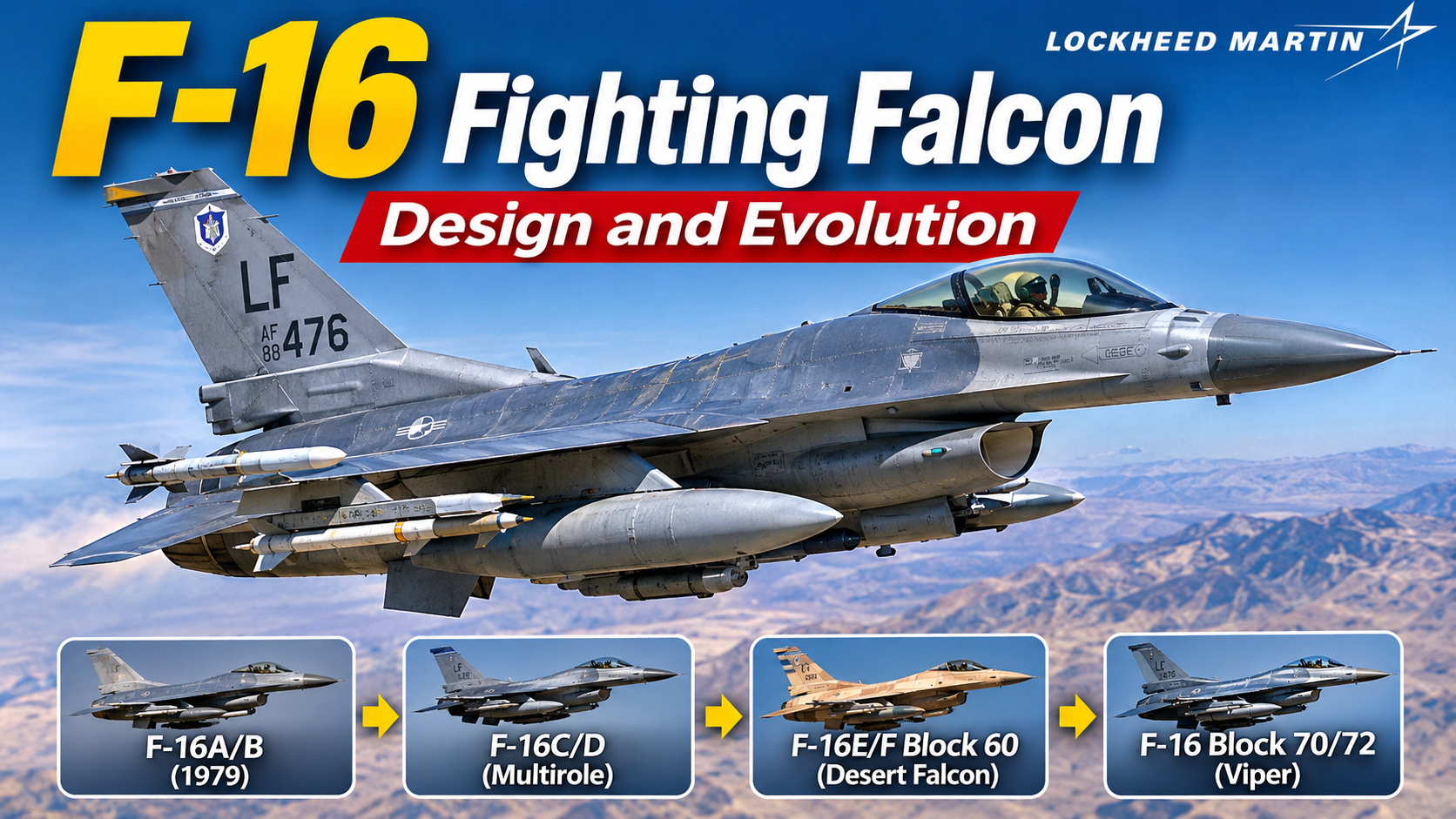
F-16A/B: The Original Generation
The initial F-16A and two-seat F-16B established the aircraft’s reputation for agility and efficient design. Early versions concentrated primarily on air-to-air combat, although ground-attack capability was also incorporated.
F-16C/D: Expanded Multirole Capability
Introduced during the 1980s, the F-16C and F-16D incorporated improved avionics, radar, cockpit technology, and expanded weapons compatibility. Subsequent production blocks further improved targeting, night operations, navigation, and electronic warfare capabilities.
F-16E/F Block 60: UAE Desert Falcon
The F-16E/F Block 60 was developed specifically for the United Arab Emirates. Compared with earlier versions, it introduced major improvements in propulsion, avionics, radar, electronic warfare systems, and fuel capacity.
The first Block 60 aircraft flew on December 6, 2003. The UAE ordered 80 aircraft, with the first aircraft arriving in the country in May 2005.
F-16 Block 70/72: The Modern Viper
The modern Block 70/72 incorporates an AN/APG-83 Active Electronically Scanned Array radar, advanced mission computer, upgraded cockpit displays, digital communication systems, and Automatic Ground Collision Avoidance System technology.
Lockheed Martin specifies a structural service life of 12,000 flight hours for this production generation, reflecting the extensive redesign and modernization of the original platform.

Radar, Avionics and Weapons Integration
One of the F-16’s greatest strengths is its ability to accommodate increasingly sophisticated electronic systems. Earlier variants used mechanically scanned radar, while more advanced configurations feature electronically scanned arrays with improved detection and tracking performance.
Modern aircraft can integrate advanced navigation equipment, targeting pods, electronic countermeasures, data links, and a broad selection of air-to-air and air-to-ground weapons.
These improvements allow the F-16 to operate in a range of missions without fundamentally changing its aerodynamic design.
Operational History and Global Influence
The Fighting Falcon has participated in numerous military operations and has served with air forces around the world.
Its operational flexibility, extensive maintenance infrastructure, and ongoing modernization options have made it attractive to countries seeking a capable multirole fighter platform.
According to Lockheed Martin’s June 2026 program figures, approximately 2,800 F-16 aircraft were operating across 29 countries, reflecting the aircraft’s remarkable international reach.

Why the F-16 Remains Relevant
The F-16’s continued success demonstrates that fighter aircraft effectiveness is not determined by maximum speed alone. Aerodynamic efficiency, electronic modernization, maintenance support, training, and mission flexibility are equally important.
Although newer stealth aircraft offer capabilities that the original F-16 was never designed to provide, advanced Fighting Falcon variants remain valuable for many air forces.
The aircraft’s modular upgrades and established support network have allowed operators to keep improving their fleets without replacing the entire platform.
Conclusion
From a lightweight fighter prototype to a modern multirole combat aircraft, the F-16 Fighting Falcon represents a remarkable achievement in aerospace engineering.
Its pioneering fly-by-wire controls, agile aerodynamic configuration, adaptable electronic systems, and continual modernization have contributed to an operational history spanning nearly half a century.
The evolution from the early F-16A to the UAE’s Desert Falcon and modern Block 70/72 Viper demonstrates how a successful aircraft design can adapt to changing technology and operational requirements.